The Irish-Japanese Axis

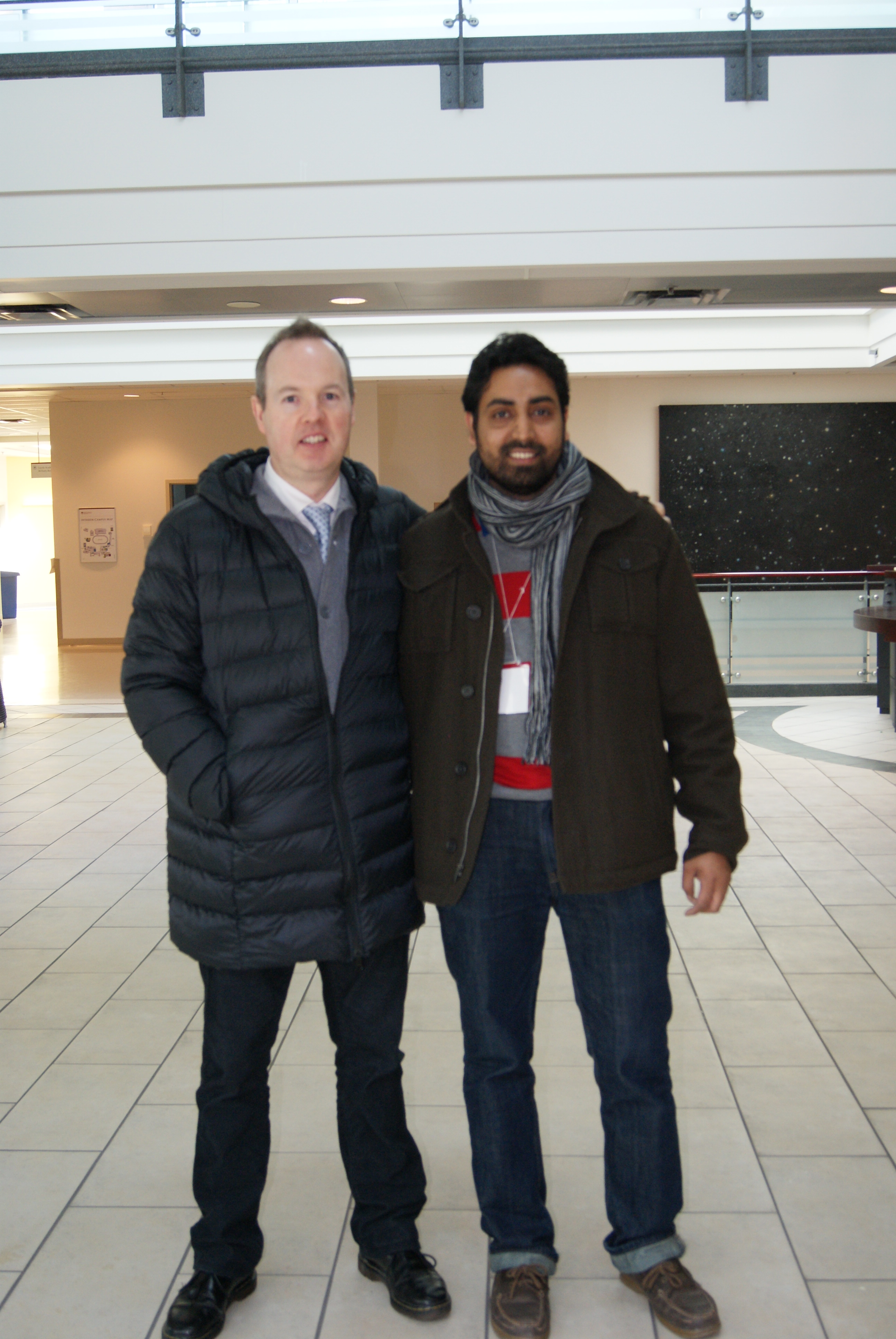
IMG_0827At a session on De Facto state regimes at last month’s ASN, Tom de Waal wittily remarked on how there appears to be an Irish-Japanese axis of researchers studying these oddities of the world political map. Looking at the presenters he was surely right. Kimitaka Matsuzato has long brazed a unique trail with his research in the North and South Caucasus, his ASN paper updating and revising research he had undertaken in South Ossetia immediately after the August War, as well his longstanding research in Abkhazia. Donnacha O’Beachain, from Dublin City University, has developed deep knowledge of elections in the post-Soviet de facto states, having visited three of the four for first hand observation and research during the 2011-2012 campaigns. Few may be aware that he is the author of a highly regarded history of Ireland’s ‘party of power’ until recently, Fianna Fail, entitled The Destiny of Soldiers. JohnO and I anchored the discussion. To this group could be added Yoko Hirose who has undertaken considerable research in Azerbaijan (and was in the audience).

Any full discussion of current international researchers on de facto states needs to take account of the great work by Norwegians, in particular the work of Pal Kolsto, his collaborator Helge Blakkisrud, and the UCL political scientist Kristin Baake with whom JohnO and I have cooperated. And then there is Eiki Berg in Estonia, the British in Nina Caspersen, Laurence Broers and Tom, and pretty soon the axis is more like a burgeoning matrix of cosmopolitian academics and policy analysts. One thing this growing network underscores is the passing of the era when de facto states could be described, as Charles King did more than a decade ago, as “informational black holes.” Like it or not, with the important exception of South Ossetia, de facto states are more accessible and connected than ever before. While parent states may not like this, it is a positive development for policy making and peace building. The more these regions are understood in their complexity, the more outsiders can appreciate the dilemmas and policy challenges they present and the more difficult it is to perpetuate tabloid geopolitical conceptions about them. The arc of the Enlightenment is long…..


Posted in Abkhazia, August War, De Facto States, ethnic cleansing, Five Day War, Geopolitics, Nagorno-Karabakh, Nagorny Karabakh, nationalism, Political Geography, South Ossetia, World political map | Tagged , , | Leave a comment

Mapping Europe’s Borderlands

Image

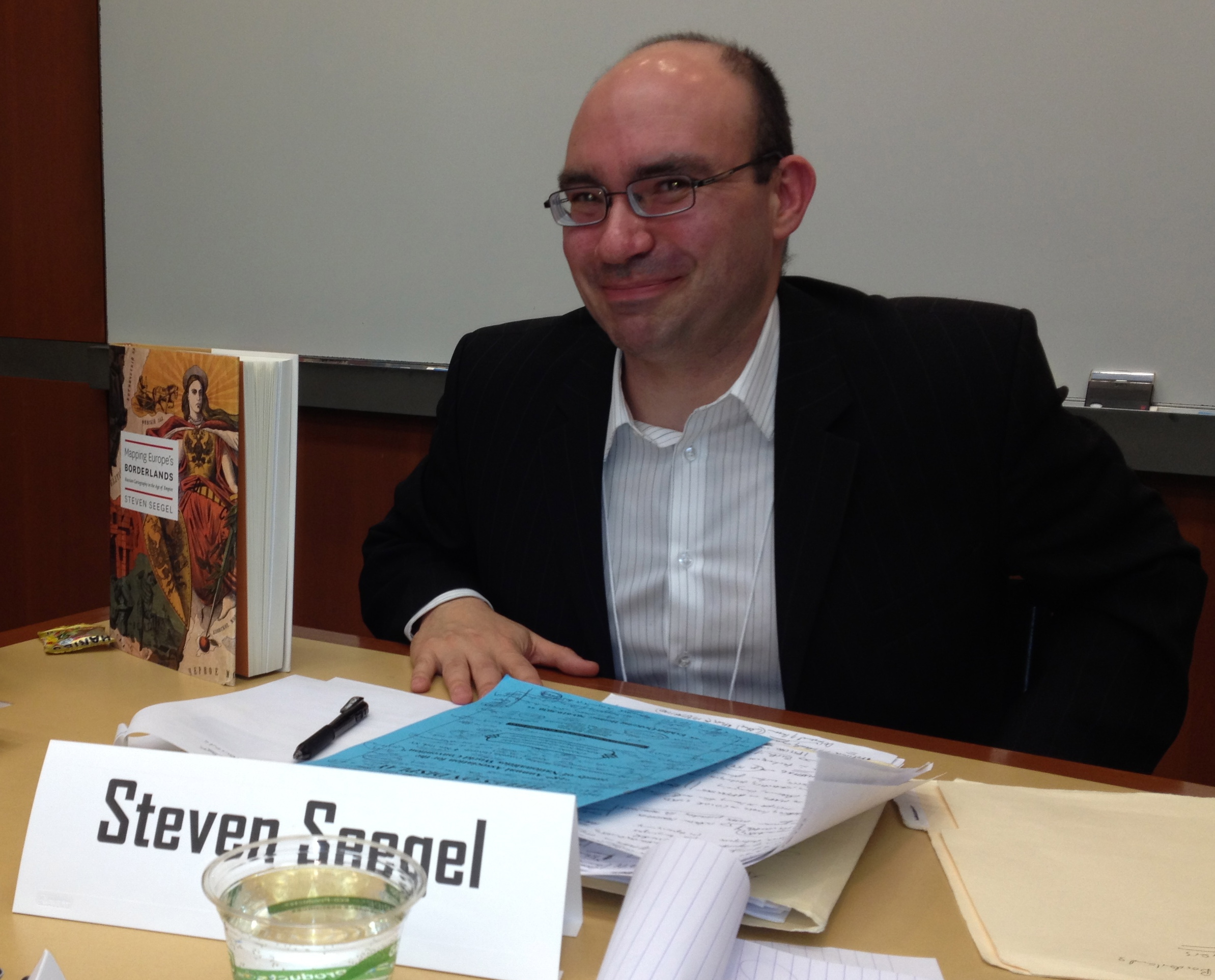
I was one of three discussants of Steven Seegel’s tremendously impressive book Mapping Europe’s Borderlands: Russian Cartography in the Age of Empire at the Association for the Study of Nationalities conference in New York on 18th April. Larry Wolfe in the Department of History at New York University and Monika Baar, in History at the University of Groningen, Netherlands and author of Historians and Nationalism: East-Central Europe in the Nineteenth Century were the other discussants. As Steven remarked, the panel had a scholar of the eighteenth century, one of the nineteenth century and myself as a representative of contemporary political geography. The discussion was lively and rightly acknowledged the tremendous academic work that went into creating this book. There was some commentary on the slightly misleading title and more obviously misleading subtitle of the book. But the University of Chicago did a beautiful job producing this volume, allowing abundant black and white map reproductions and eighteen pages of color plate maps at its center. Commentators will be gathering their thoughts for publication in a book forum in Nationalities Papers within the year.

Posted in Current affairs | Tagged , , , , | Leave a comment

The Improvised State

IMG_0770

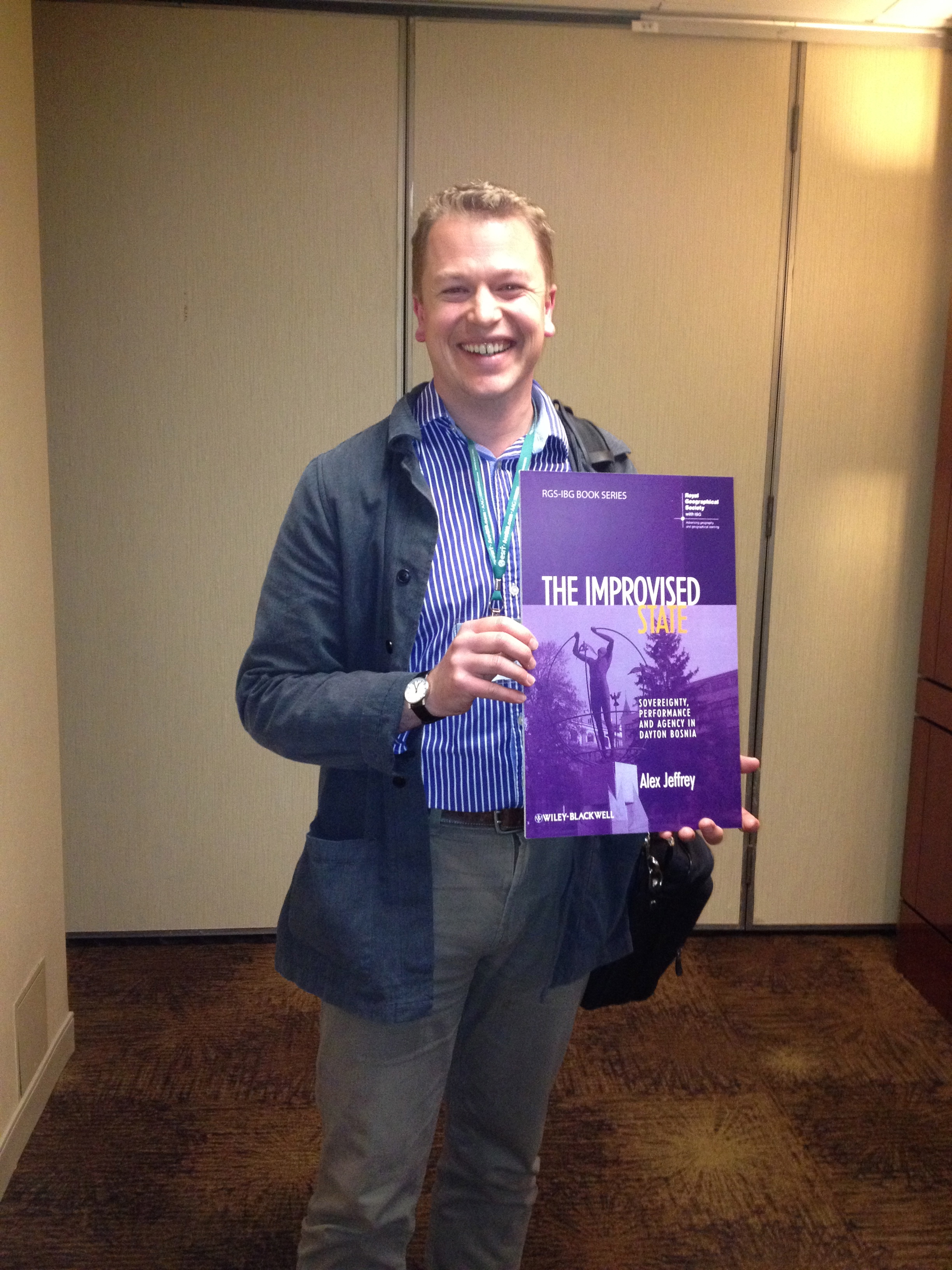
Alex Jeffrey is a lecturer in Geography at Cambridge University in the (maybe not so) United Kingdom (what say you Scotland?). He is the author of a theoretically innovative new book called The Improvised State: Sovereignty, Performance and Agency in Dayton Bosnia published by Wiley (pictured herein with the cover). He has also written a series of important articles on the ICTY and transitional justice mechanisms in Bosnia. I was among a panel of five discussants who engaged the book at the recent Association of American Geographers meeting in Los Angeles. The session was an interesting experience with one discussant remarking that it seemed we weren’t engaging the same book (which was really more a reflection of the different backgrounds of the commentators). My comments and those of the other discussants are likely to appear in a Political Geography book forum in the next year. Congratulations Alex on the book.

Posted in Bosnia, Bosnian war, Critical Geopolitics, Current affairs, Democracy, ethnic cleansing, ICTY, nationalism, Radovan Karadzic, state theory | Leave a comment

International Conference on the Future of Turkey and the Kurds

CALL FOR PAPERS:
International Conference:
The PKK, Kurdish Nationalism and the Future of Turkey
 Thursday, November 7, 2013
 Virginia Tech National Capital Region
1021 Prince Street , Alexandria, VA 22314

Organized and Sponsored by
School of Public & International Affairs, Virginia Tech, National Capital Region.
Ottoman and Modern Turkish Studies Chair (Indiana University)
 

We plan to organize an international conference on the PKK, Kurdish Nationalism and the Future of Turkey. This will be a one day conference with four specific panels. The conference will be held at the Virginia Tech Alexandria Campus, in the heart of Old Town, Alexandria, and the Washington DC metro region.
 
The objective of this conference is to understand the complex relationship between Kurds and Modern Turkey. The collapse of the Ottoman Empire left unprecedented political conditions in the region, with the formation of nation-states without any social and economic foundations. In this context, the new form of nationalism attempted to create a territory-based form of national identity; however, demographic challenges such as urban and rural demographic contradictions), a lack of higher education, lack of an established rule of law and of capital accumulation has led to instability and the formation of a non-organic type of modernization and national identity in the region and Turkey. In the meantime, transnational economic development has weakened the role of the nation-state over the last 30 years and ethnic nationalisms have emerged across the Middle East. This set the stage for the resurgence of Kurdish Nationalism in Turkey, Iraq, Syria and Iran. The Marxist-based Kurdistan Workers Party (PKK) first waged war against the Turkish Nation State in 1984. However, as a result of the social, political and economic transformations in the world and US involvement in the region, the PKK changed its ideological foundation from Marxism to nationalism in 1995, as part of the 5th PKK Congress. At this time, the Marxist star was removed from its flag and ethnic nationalist symbols and slogans were used to replace it. At the same time, more than sixty percent of the Kurdish population migrated to non-Kurdish industrialized cities in Turkey. Today, the Kurdish population in modern Turkey is more educated, urbanized, and they invest in the Western as much as the Eastern part of the country. Therefore, aspirations and objectives of Kurdish Nationalism is currently in a stage of transformation, and its objectives have begun to shift from that of obtaining an independent Kurdish State to seeking the status as equal citizens of modern Turkey. The latter objective – the integration of the Kurdish population into the larger population of Turkey – is likely to create numerous opportunities for the modernization of Turkey and the wider region. In this conference, we will explore this transformation, and possible future trajectories between Turkey and its relations with the Kurds.           
 
You will find detailed information about the conference below:
 
PANEL-1: Kurdish Nationalism in Iran, Iraq and Syria
We welcome submissions related to, but not limited to the following subjects:
•    Kurdish nationalism in Iran
•    Kurdish nationalism in Iraq
•    Kurdish nationalism in Syria
•    Kurdish nationalism in the Diaspora
 
PANEL-2: Kurdish Nationalism in Contemporary Turkey
We welcome submissions related to, but not limited to the following subjects:
•    Kurdish Nationalism in historical context
•    Kurdish and Turkish nationalisms
•    Imperialism and Kurdish nationalism
•    American foreign policy towards Turkey and the Kurds
 
PANEL-3: PKK and Kurdish Nationalism
We welcome submissions related to, but not limited to the following subjects:
•    Origin and development of the PKK
•    The PKK and the ‘war on terrorism.’
•    Relationship between the PKK, the US and Europe
 
PANEL-4: The Kurds and the Future of Turkey
We welcome submissions related to, but not limited to the following subjects:
•    The future relationship between Kurds and Turkey
•    JDP and Kurdish Nationalism
•    Kurdish regional government and Turkey
•    Future trajectories of American foreign policy towards Turkey and the Kurds
•    Future trajectories of Turkish and Kurdish politics  
 
Please submit your interest, with a short abstract (300-400 Words) and short bio (100-200 words). The deadline for abstract submissions is Monday, August 19th 2013. The authors of accepted papers will be notified by September 1st 2013.
 
Please submit your paper to the following address: tugrulk@vt.edu
 
If you have any questions, please do not hesitate contact us.
 
Dr. Kemal Silay, Professor of Turkish Language and Literature; Ottoman and Modern Turkish Studies Endowed Chair Professor; Director, Turkish Language Flagship Center; Director, Turkish Studies Program;

Indiana University

Dr. Tugrul Keskin, Assistant Professor of International and Middle East Studies; Affiliated Faculty of Black Studies Sociology, and Turkish Studies; Portland State University


Tugrul Keskin

Assistant Professor of International and Middle Eastern Studies
Affiliated Faculty of Black Studies
Sociology and Center for Turkish Studies
Middle East Studies Coordinator (INTL)
Portland State University

Editor of Sociology of Islam Journal (Brill)
http://www.brill.nl/sociology-islam
Book Review Editor for the Societies Without Borders
http://societieswithoutborders.com/  
International Studies and Global Sociology
http://internationalstudiesandsociology.blogspot.com/

Posted in Current affairs | Tagged , , , , , | Leave a comment

Geography’s Oscars: John O’Loughlin’s Distinguished Scholarship Award

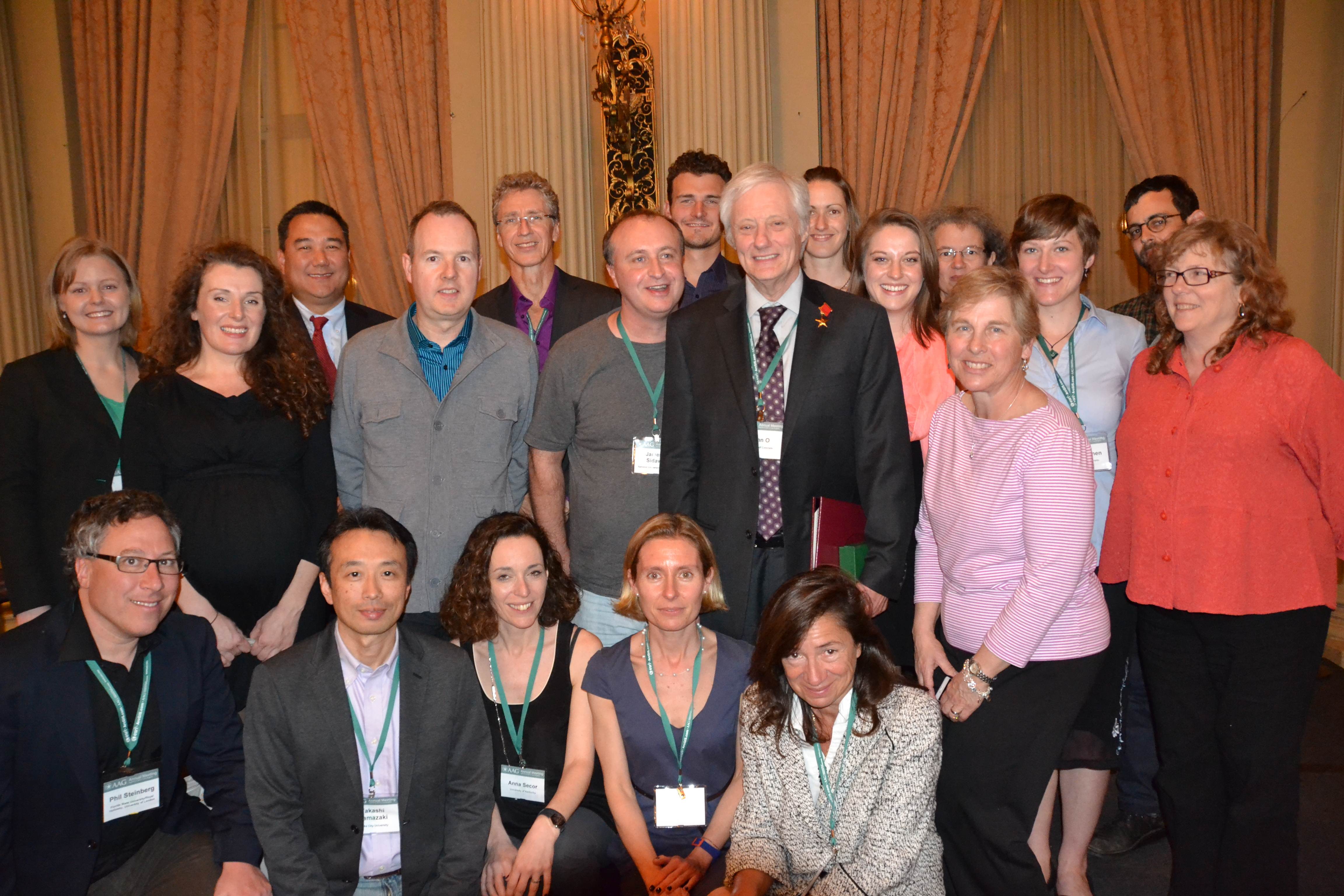
JohnoLunchGroup2The Association of American Geographers gathered in the Crystal Ballroom of the Biltmore Hotel on 13th of April 2013 for an awards luncheon. The location was an appropriate one to dispense awards as it was the site of a series of early American Academy of Motion Picture Arts and Sciences Awards. Among those honored was the great Edward Soja, fittingly feted in the city he has written about for decades, and Sally Marston. I was part of a two table group to honor my first graduate academic adviser, and ongoing research collaborator, Dr John O’Loughlin. JohnO as he is affectionately known by his now legions of graduate students and friends, was honored for Distinguished Scholarship, an award he richly deserves as he has produced a remarkable corpus of research articles and books from the nineteen seventies to today. He is also held in high esteem by his former and current graduate students, and others, for many many qualities beyond his research productivity and excellence. Exhortation to hard work through humor is an abiding quality, one suitably honored by his ‘clan’ with an extra award on the day, that of Soviet ‘Hero of Labor‘ (a category of praise he has used for decades for those slaving away on research projects). Unlike the Soviet original, this one was truly a ‘bottom up’ award for a genuinely inspiring figure in the discipline of Geography and beyond. Congratulations JohnO. ‘Tis a pleasure to be working with you.

POSTSCRIPT.

Sometimes you can’t make things up! Putin Brings Back ‘Hero of Labor’ Medal

Posted in Current affairs | Leave a comment

Conference Season

Each year different tribes of academic laborers have their trade shows. This laborer is attending two virtually back to back, the Association of American Geographers meeting in Los Angeles and then the Association for the Study of Nationalities conference in New York the following week. I’m involved in three events at each. At the AAG I am on two book panels. The first is on Alex Jeffrey’s The Improvised State: Sovereignty, Performance and Agency in Dayton Bosnia (Wiley Blackwell, 2012), the second Thomas Medvetz’s Think Tanks in America (University of Chicago Press, 2012). I am also presenting a paper, a gathering of thoughts on the August War of 2008, on the notion of ‘affective geopolitics’ in one session in a series on ‘Violence and Space’ organized by Simon Springer and Philip Le Billon at the Department of Geography at the University of British Columbia.

Like last year at the ASN, I am involved in the presentation of two papers. The first is “Land for Peace in Nagorny Karabakh? Political Geographies and Public Attitudes in a De Facto State” which is the latest in a series of papers from the De Facto State Research Project with Dr John O’Loughlin. The second is “Where is Serbia? Self-Positioning Traditions in Serbian Geopolitical Culture” which will be presented by and was mostly written by a visiting post-doc at Virginia Tech NCR, Dr Bojan Savic. Drafts of both papers are written and will be in the ASN conference CD. I am also a discussant at a book panel on Steven Seegel’s Mapping Europe’s Borderlands: Russian Cartography in the Age of Empire (University of Chicago Press, 2012). Lots of laboring ahead.

Posted in Caucasus conflict, Critical Geopolitics, Current affairs, De Facto States, ethnic cleansing, Five Day War, Nagorno-Karabakh, Nagorny Karabakh, nationalism, Political Geography, South Ossetia | Tagged | 2 Comments

Unfinished Business in Northern Ireland

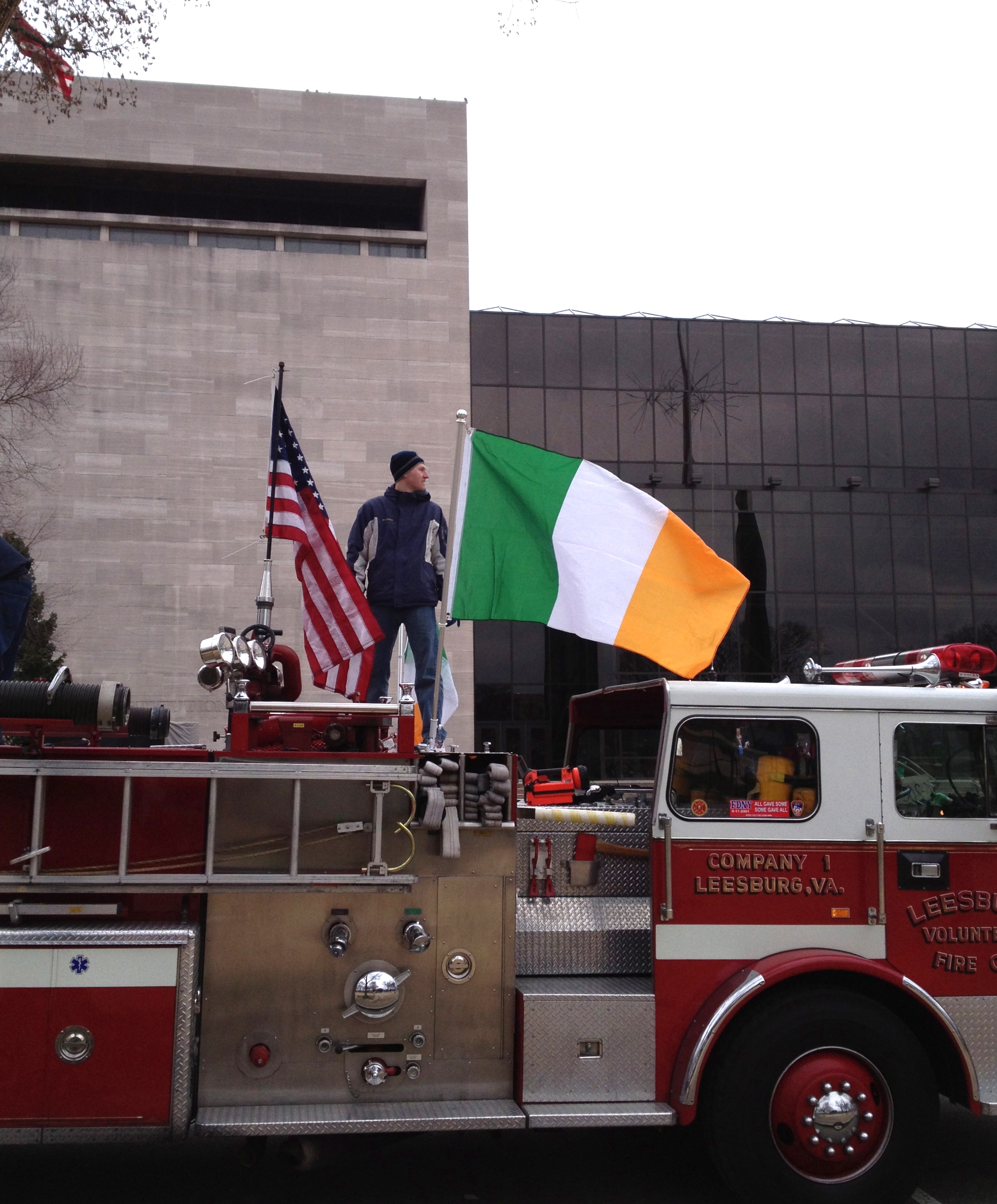
IMG_0741_2“Happy Saint Patrick’s Week.” That was the conclusion of the speech by the Irish Taoiseach (Prime Minister) Enda Kenny at the Westin Park Hotel on Tuesday night. The once religious holiday has become a week long series of breakfasts, lunches, dinners, panels, parades and receptions here in DC and in New York and Chicago. Ireland is deeply fortunate to not only have such a historic connection to the United States but to have a ‘day’ all to itself that warrants ‘celebration’ across the US (Irish pubs help). Irish politicians celebrate St Patrick’s by flying to New York, Chicago and Washington DC where US politicians oblige them by wearing green ties and accepting bowls of shamrocks (pictured above is one of the firetrucks that took part in the St Pat’s Parade on the Mall; no bowl of shamrock agreed to participate in this post).

Amidst the frivolity there is an opportunity for some serious business and diplomacy. Immigration reform, foreign investment and tourism are major national interests for the Irish government, and as holders of the Presidency of the EU right now, it is also helping launch the Transatlantic Free Trade Agreement negotiations. But this year, the issue of unfinished business in Northern Ireland also got some attention. On Monday I attended a very informative Roundtable at Brookings with Professor Michael O’Flaherty on Human Rights in Northern Ireland. The discussion was particularly informative as I had not followed Northern Ireland closely for a while. I left with seven ‘takeaway’ points.

  1. Parts of the Good Friday Agreement remain unimplemented, especially the Bill of Rights.
  2. The degree to which Northern Ireland’s institutions are “Weston Park compliant” is a work in progress.
  3. The Civic Forum is moribund.
  4. There is a requirement on the state to provide good governance but social housing remains 90% segregated, 93% of kids go to ‘dominantly’ segregated schools and 99 security barriers are still in place across Belfast.
  5. Transitional Justice remains incoherent and spotty.
  6. There is a persistent problem with paramilitaries, as recent rioting over the display of a flag above City Hall in Belfast underscored.
  7. There is disdain for ‘human rights’ among some in NI who associated it with ‘civil rights’ and, therefore, a ‘Catholic agenda.’

At this event and later I had the opportunity to meet the Finucane family. They are campaigning for a public inquiry into the murder of Pat Finucane, husband and father. For those unfamiliar with the case see here or read Ch 2 of Kevin Toolis’s Rebel Hearts. With commendable motives but also desire to ‘move on’ with a ‘resolved’ Northern Ireland, the British government has undertaken a series of inquiries into infamous episodes of the Troubles. Considerable media attention was devoted to the 5,000 page 2010 Bloody Sunday Report. Less well received was the Sir Desmond De Silva Report, released in December 2012, which Geraldine Finucane described as a ‘whitewash’.

At least two issues are at stake, from what I can determine, in this case. The first is trust, legitimacy and ownership. Prime Minister Cameron did not give the family any input into the process of shaping the inquiry and determining who was appointed to run it. This was an avoidable mistake. The second concerns public accountability. From what I understand (a euphemism for ‘I haven’t read the report’) the De Silva Report is extensive and in-depth in its documentation of the shocking level of collusion between British security officials in Northern Ireland and Loyalist paramilitaries. Where it is reportedly weak is in exploring the role of political authorities in creating an environment where such practices could take root, and have sanction. This is understandably difficult for any state. The US, for example, has not held hearings on the sanctioning of illegal interrogation methods during the global ‘war on terror’ nor have any politicians faced public scrutiny for their role in ginning up dubious intelligence to justify the invasion of Iraq. But democracy needs public accountability and the rule of law inviolable standards of justice if it is to remain robust and legitimate.

These issues transcend Northern Ireland. State security forces using special emergency powers to, in the end, murder their own citizens resonates with recent US debate over drones (see Ron Wyden’s questions). What powers should the ‘national security state’ have and who holds them accountable for their actions? When is suspension of law in the pursuit of perceived national security ends justified, if at all? The tragedy of the Finucane case is that British security officials helped direct the murder of a man representing an achievement of their/our civilization, namely the rule of law and the principle of innocence until proven otherwise. The inability to distinguish a lawyer representing ‘terrorists’ from the ‘terrorists’ themselves was, no doubt, a product of the sectarian atmosphere in Northern Ireland during the Troubles. Unfortunately, this polarizing sectarian attitude, this impulse to ‘paint’ individuals with orange or green, appears to still haunt this case: some refuse categories other than Republican or Loyalist, Them or Us. For evidence of this sad fact, one need look no further than the comment stream after Beatrix Campbell’s opinion piece on the De Silva report in the Guardian newspaper. Hopefully, the Finucane family will have the public inquiry they deserve. The strength and legitimacy of practices of political accountability will be the better for it.

POSTSCRIPT: Ambivalent “Lessons Learned.”

Citing a “former top British intelligence officer who had over the brutal British campaign to crush the IRA for ten years” Jane Mayer in The Dark Side (p. 30) writes:

“You need to learn from our history” the Englishman warned. He then recounted how former British Prime Minister Margaret Thatcher had become enraged and panicked following the IRA’s bombing of the Conservative Party conference meeting in Brighton in 1984, in which five died and the bathroom of her own hotel room was blasted. In response he said “We decided to turn the terrorists’ tactics back on them.” He noted, “For a time, it worked. It stopped the immediate attacks But watch out,” he warned. “It’s dangerous. It makes you the bad guys. And when it gets to court — and in your society, just like ours, it will — every one of these guys will get off.”

Posted in Current affairs, Democracy, Northern Ireland | Tagged , , , , | Leave a comment

Climate Refugees of Bangladesh

SONY DSC

There was some debate at CARFMS on the category of ‘climate refugees,’ whether this is a useful construct or a problematic conceptualization and narrative. Ted Itani, a deeply experienced former United Nations official now affiliated with the Pearson Centre at the University of Toronto, made the important point that within the next fifteen years the citizens of certain states, like the Maldives, will no longer have a homeland because of rising ocean levels.

The issue of the impact of climate change on already vulnerable populations within stressed states and societies was given powerful visual form by Kevin Boiragi, a graduate student and documentary film director who presented his film Climate Refugees of Bangladesh (pictured). The film is available for viewing at: vision.rcinet.ca and on Google-is-tracking YouTube.

http://vision.rcinet.ca/video/KWGK13BGY5HG/Climate-Refugees-Of-Bangladesh-part-1/

A final noteworthy presentation was by Carleton University Professor Jay Drydyk who’s book (co-authored with G. Peter Penz)  Displaced by Development  is an attempt to think through and elaborate the rights that people facing displacement should enjoy based on agreed values. The values he and his co-author listed and he discussed are:

  1. Well-being
  2. Equity
  3. Empowerment
  4. Environmental sustainability
  5. Human rights
  6. Cultural freedom
  7. Integrity in relation to corruption

The four moral rights they identify are:

  1. Right of non-victimization.
  2. Right of equitable sharing in benefits.
  3. Right of good reason.
  4. Right of equitable empowerment.

This was also a videotaped presentation and I will link to it when it becomes available.

Posted in Bangladesh, Climate Change, Global Warming, Rights | Tagged , , | Leave a comment

Reversing Ethnic Cleansing: Is It Possible Peacefully?

On 10 March I gave the closing keynote at the 6th Annual Conference of the Canadian Association for Refugee and Forced Migration Studies (CARFMS). The topic of my talk was Reversing Ethnic Cleansing: Bosnia’s Experience and Protracted Displacement in the South Caucasus. It reviewed the nature of Bosnia’s effort to reverse ethnic cleansing, its evolution from a ‘right of return’ to a ‘return of rights’ in Philpott’s construction and the impact of Bosnia on the development of ‘soft law’ like the Pinheiro Principles. The talk then reviewed the different experiences of forced displacement in Abkhazia, South Ossetia and Karabakh (and surrounding territories) before getting to the question of the limits and indeed potential dangers of ‘reversing ethnic cleansing.’ The talk is a gathering of thoughts for future work; it is, in other words, a work in progress. The presentation was recorded and I’ll post a link to it when I learn where it is posted.

I thoroughly enjoyed the conference and learning about how much more comprehensive and supportive Canada’s system of refugee integration is compared to that in the United States. British Columbia’s placement of ‘settlement workers’ inside large school districts, for example, seems a model program that many places could learn from (presentations by Tara Holt and Meredith Verma). Many thanks to the conference organizers (in particular Morgan Poteet) for putting together a dynamic conference for inviting me to be a part of it.Image

Posted in Abkhazia, August War, Bosnia, Bosnian war, Caucasus conflict, Current affairs, ethnic cleansing, forced displacement, genocide, Georgia, nationalism, Pinheiro Principles, restitution, South Ossetia, World political map | Tagged , | Leave a comment

The Rhetorical Politics of Milorad Dodik

reg-dodikMy essay on the former prime minister and current president of Republika Srpska has just been published in the Discussion section of the journal Nationalities Papers, a Taylor and Francis journal (41, 1: 160-204). I’m grateful to the departing editor Florian Bieber for accommodating such a long study on the topic of Republika Srpska and its future status within Bosnia-Herzegovina. The essay is followed by two responses, both of which I’m keen to read as I still haven’t seen a paperback copy of the issue and our university, beset by retracting library budgets, only subscribes to the journal with an 18 month delay.

Posted in Bosnia, Bosnian war, Current affairs, Democracy, nationalism, Rhetoric, World political map | Tagged , | Leave a comment