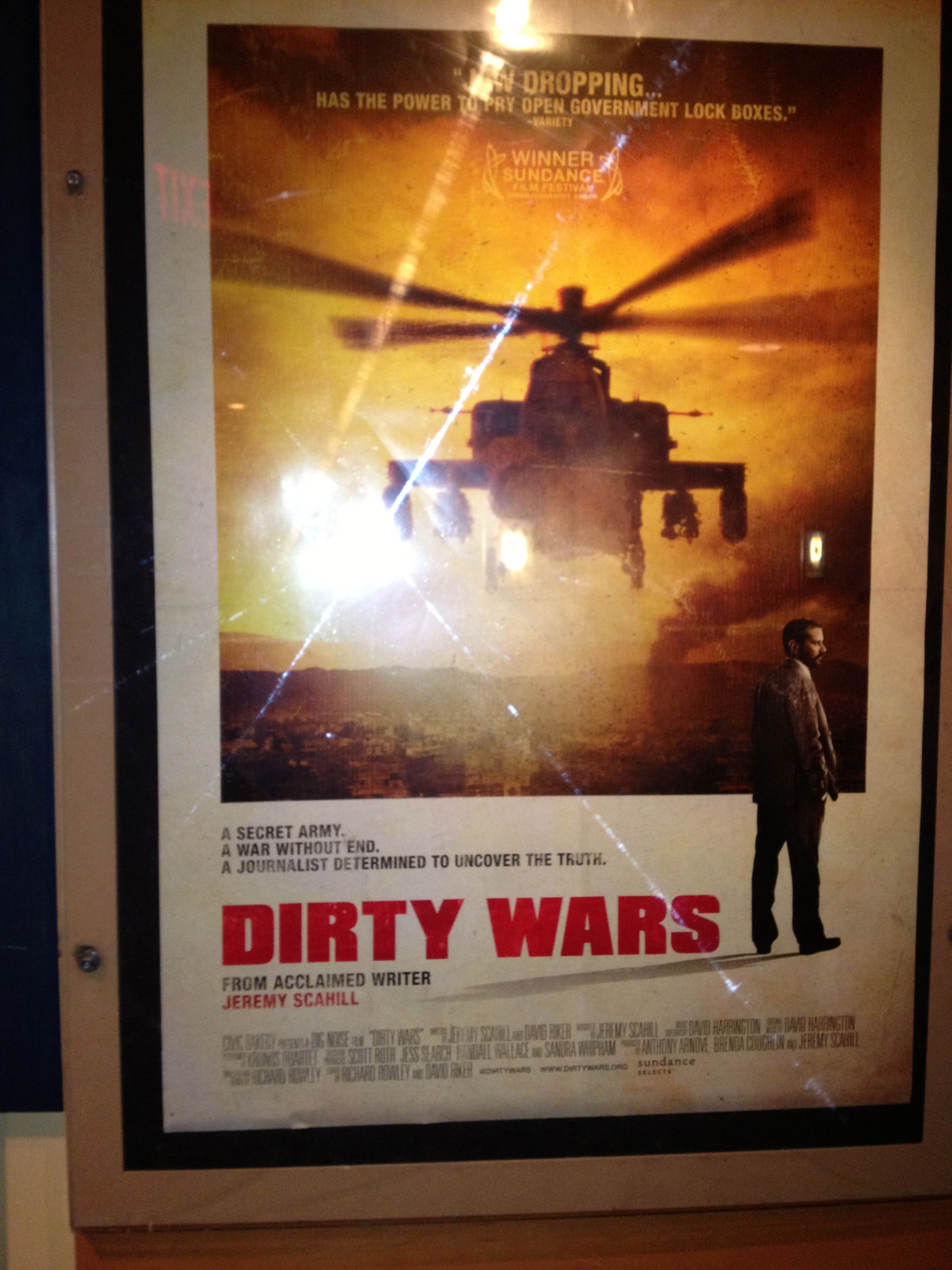
‘Dirty Wars’ Washington premier at E Street cinema

IMG_0965Because the initial showing sold out E Street switched the show to Theatre 4, their largest, and it was almost full by showtime. Despite the topic, the US corn industry had a good night as people were shoveling the stuff into themselves while sipping on the finest high fructose from the plains. After about 15 minutes, however, the munching stopped and the theatre was silent.

The film frames its subject as that which ‘is hiding in plain sight.’ It is organized around Scahill’s work as an investigative journalist for The Nation on national security affairs. His presence unites the disparate parts but he’s no adrenaline junkie. He’s shown working, writing in his notebook, listening, and also being afraid, brooding, tying in his computer, being intense, overwhelmed and burdened by it all. He described himself as ‘gutted’ on All In on Thursday and this comes across to a degree (the classic in/out of war zone disjuncture is depicted as we see him in his neighborhood in Brooklyn). Despite his shades and black garb, there is no showboating masculinity by Scahill in the film (which was refreshing). He appears as earnest and intense, and disturbed by what he’s encountering.

It begins with Afghanistan and Scahill tracking down a night raid that seemingly went awry. He ventures on the dangerous journey beyond Kabul and meets the family of the victims who relate their story. Through some chance video and photographs (and how omnipresent visual recording devices are changing what we know and believe is a theme of the film) he is able to tie the raid back to JSOC (he interviews another reporter who broke the story first, a somewhat unusual move in what must be a highly competitive profession). He then provides some background on this group — essentially a presidential paramilitary unit — and there are scenes of Washington DC (66, Tysons Corner, etc) before he focuses on his core subject which is the US terrorist assassination program, in bureaucratize ‘High Value Targeting’. He makes his first trip to Yemen to chase down a report on a drone strike in southern Yemen that murdered many poor tribesmen. We see the familiar marking on the drone (General Dynamics, Rosemount) and meet the Yemeni journalist Abdulelah Haider Shaye who was imprisoned for writing about it. The film suggests that Obama personally requested that Ali Abdullah Saleh keep him in prison (he’s apparently STILL in prison in Yemen, according to Scahill).
IMG_0966The failed Christmas day bombing leads to the emergence of Anwar Al Awlaki, an American citizen, as a new terrorist mastermind that is, in effect, on the ‘kill list.’ He tries to find him in Yemen and fails but does manage to talk to his father. Its a fascinating story, one told in Chapter 2 of the book. Thereafter the film moves back to Washington, the killing of OBL, and Scahill’s trip to Somalia. This receives scant coverage (he indicated they had a 4 four version of the film before Sundance which provided all the background and further details) but enough to convey the message that the US is allied to some unsavory warlords in Mogadishu like Yusuf Mohammed Siad (Indha Adde). He then learns of the drone strikes that kill Al Awlaki and then, stunningly, his 16 year old son. This leads to a return to Yemen and a heartbreaking tale of loss from a grandfather and grandmother.

Throughout the film the faces of children feature prominently. Its difficult, especially if you’ve young girls like I have, to watch sometimes. Pregnant women getting murdered are also cited at the outset and again on another occasion. This was, as Scahill stated afterwards, a conscious choice of the filmmakers, to put ‘a human face’ on what the US’s ‘war on terror’ looks like on ground and in the eyes of children far away from this country. The cinematography uses mainline techno-spy thriller film devices to site and situate, black and white still shots with detailing information techno-type scrolled. Many of its landscape shots are beautiful. It is, in short, a very polished film, not polemical, just disturbing and questioning.

IMG_0967After the credits rolled, the film got a round of applause and then a more sustained one followed as Scahill came out and answered questions. The first comment, a sincerely moved audience member, cited a comparison to Hitler (which was not a good start). Another man from Nigeria wanted to give him information on what was happening in his country. I recorded some of 20 minutes of the 40 minute exchange, including a question I posed about his perspective on the continuities between the Bush administration and the Obama administration. For me, this is a key question as evocations of a shared ‘mentality’ or ‘the system’ are inadequate. In addressing it, he cited something I’ve heard him say before, namely that liberals have ‘checked in their conscience’ with Obama. He cited the case of Obama still using rendition through sub-contracting it to various groups in Africa, mentioning a flight from Kenya to Somalia and an underground prison. I believe its in the book but I haven’t got that far yet.

But this leaves the larger question unanswered. How did an anti-dumb war, civil liberties championing constitutional law professor get so enveloped that he doubled down on certain modalities of the war on terror established by Bush? Was this a political anxiety (or ‘seize the flag from the right’ project) that Democrats should always appear ‘tough’ as well as ‘smart’ on national security? Was this a desire by this once outsider and subsequent product of the establishment to still demonstrate, to perpetually demonstrate to the permanent national security state, that he really was one of them, that he believed the same things? Was this a product of the seduction of the Washington power game, of the gravitational pull of the enormous mightier-than-one-president ‘top secret America’ post-9/11 state? Or was this the inevitable ‘growth’ of a leader as they transition from being a candidate assembling a winning coalition to a president charged with the weight of government? Part of winning is seducing some groups (civil liberties democrats) while marginalizing others (there’s a scene where a Pentagon reporter cites what is presumably one of his articles in The Nation and this prompt elicits a ‘conspiracy theory’ tag from the spokesperson)? I believe historians of his presidency will be debating these questions. Geographers, hopefully, will have rich books out on geographies of the war on terror out in the next few years (Derek Gregory’s Everywhere War is much anticipated).

Scahill’s world is that of the investigative reporter. He’s focused on the facts, details and lines of connection that reveal abuse of power and extra-constitutional excess. Don’t expect to have Agamben cited. That is the power and value of his work. It gets under the skin of the conventional wisdom and general consensus on the war on terror. It disturbs. With the journalistic revelations of the last week (and there’s a lot more coming from what Scahill indicated; he also mentioned how journalists are now changing their digital behavior in big ways), the whole  everywhere endless terror security surveillance state is cracking open before our eyes. Its not hiding in plain sight anymore.
Posted in Current affairs, Dirty Wars, drones, Jeremy Scahill, Obama, Somalia, war on terror, Washington D.C., Yemen | 3 Comments

The Bordering of South Ossetia

Having grown up in a contested border region during the Northern Ireland Troubles, I’m familiar with the trepidation and tragedy that often accompanies projects to harden borders, to militarize them in the name of state security. As our recent article outlines, South Ossetia like Abkhazia has sought to more definitely stake out for itself ‘state sovereign territory.’ This has produced a wave of  material practices of bordering since 2008 when Russia declared it was recognizing these breakaway territories as independent states. More so that in Abkhazia, (which relies on the Inguri for part of its border), this process has been deeply controversial in South Ossetia where borders were more fluid and penetrable before 2008, and where the SOAO (South Ossetian Autonomous Oblast) had little to no visible footprint on the landscape of Soviet Georgia.

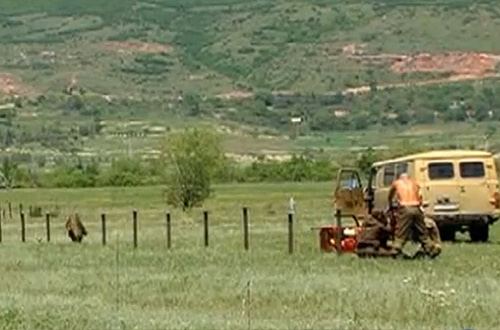
fencing-SOssetiaAdminBorderFrom the CIVIL.GE WEBSITE: A screengrab from TV footage showing Russian troops installing fencing poles in the vicinity of the village of Ditsi close to the South Ossetian administrative boundary line on May 27, 2013.

The consequences of these actions are predictably dire for local communities living along what has now become an ‘international border’ to Russia and the South Ossetian Republic, and an ‘administrative boundary line’ to the Georgian government. My friend Tabib Huseynov did a terrific report for Safer World on the population in this area (available here). So also did Care International earlier on IDPs in the region: “Community Perceptions and Conflict Prevention Needs in the Georgian South Ossetian Boundary Area
and among IDPs in Georgia” (which doesn’t seem to be readily available on the net).

Now, the Russian and South Ossetian forces are seeking to physically demarcate the border through barbed wire and border posts in the lands near the villages of Ditsi and Dvani. For video on the reactions of local villagers see this RFERL piece.

The Civil Georgia website has a series of important stories on the process of bordering.

Predictably, this border demarcation has been aggressive, deeply contested, and a political football within Georgia.

Today, one can drive across the border between the Republic of Ireland and Northern Ireland without stopping or difficulties. In the weeds on the side of the road, the eagle eyed can spy amidst the overgrown grass and weeds the ruins of previous customs and army border installations. In this fact, something I’m happy to have seen in my lifetime, there is hope for a better future for Georgia and South Ossetia. It will take time but maybe not as long as most pessimistic realists (of which I’m one) think.

Posted in Current affairs | Leave a comment

Inside South Ossetia article published

ImageThe article “Inside South Ossetia: a survey of attitudes in a de facto state” has just been published by Post-Soviet Affairs (now owned by Taylor & Francis). This article is based on a research field trip conducted in 2010 and the commissioning of a public opinion survey thereafter. The article discusses the circumstances and difficulties involved in researching this, and other de facto states. Below is the Abstract.

South Ossetia was the main site of the August 2008 war between Georgian military forces, local South Ossetian forces, and the Russian military. Soon thereafter, the Russian Federation recognized the territory as a state, the South Ossetian Republic. This article reviews the contending scripts used to understand South Ossetia and the basis of its claim to be a state. Presenting the results of a public opinion survey of Ossetians living in the territory in late 2010, we discuss the trust in local institutions and leadership, ethnic Ossetian attitudes toward other groups, return and property, as well as relations with Russia and Georgia.

Keywords: South Ossetia; Russia; Georgia; post-conflict; unrecognized de facto state

Posted in August War, Caucasus conflict, Current affairs, De Facto States, ethnic cleansing, Five Day War, forced displacement, Geography, Geopolitics, George Bush, Georgia, nationalism, Political Geography, Saakashvili, South Ossetia, World political map | Tagged , | Leave a comment

The Endless Everywhere War? America’s War of Terror, 1.0, 2.0, 3.0….

DirtyWarsAsked at a Senate hearing yesterday how long the war on terrorism will last, Michael Sheehan, the assistant secretary of defense for special operations and low-intensity conflict, answered: “At least 10 to 20 years...”  A spokeswoman later clarified that Sheehan meant the conflict is likely to last 10 to 20 more years from today. As Spencer Ackerman wrote: “Welcome to America’s Thirty Year War.”

Ever since the Bush administration’s militarized response to 9/11 there has been debate within the US national security community about the implications of a ‘boundless war’ and potentially ‘endless’ war. A whole military-security-defense complex congealed around this ‘war on terror’ while smaller states maneuvered to position themselves as allies of the US and its new strategic agenda. The Bush administration gave us the Global War on Terror (GWOT), the original, 1.0 War on Terror. Its modalities featured high profile regime change operations, US ‘boots on the ground’ and counter-insurgency as its responsive doctrine to encounters with the blow-back from imperial governance and strategic blunders.

Even before its end, the Bush administration had ditched the GWOT and began transitioning to a War on Terror, 2.0. This transition took some time though and bridged the second Bush and first Obama administration. Here the modalities were different: lower profile special operations, drone strikes in Af-Pak and Yemen, and a counter-terrorism doctrine (after Obama choose, for political purposes, to briefly surge the counter-insurgency effort in Afghanistan).

What appears to be enduring is (i) the perception that the war on terror is not going to end soon, that the original 2001 Authorization to Use Military Force against al-Qaida is still relevant and needs to remain because Al Qaeda and “associated forces” are proliferating and (ii) that the battlefield is global and, therefore, that the US military requires global military capacities, and technological systems, to respond to this threat. The ‘endless everywhere’ principles, thus, seem to be intact, and a recipe for a permanent war on terror complex (a deep state, a top secret America) within the US.

The questions Ian Lustik raised years ago in his excellent Trapped in the War on Terror are more relevant than ever. To the burgeoning literature on critique of the assumptions and practices characterizing America’s war on terror comes Jeremy Scahill’s latest book which I have sitting before me on my desk, Dirty Wars: The World is a Battlefield. There’s also a documentary of the same name about to be released. I’ll post on these as a find time to work through them. I don’t expect it will be pleasant reading.

How this plays politically is interesting. At yesterday’s hearing, it was Republicans and Independents who appeared most critical. Angus King (I-Maine) criticized the use of the phrase “associated forces.” “You guys have invented this term, associated forces, that’s nowhere in this document [the original 2001 authorization],” King said. “It’s the justification for everything, and it renders the war powers of Congress null and void.” Sen. John McCain (R-Ariz.), expressed incredulity over the Pentagon’s broad interpretation of the AUMF. “None of us” who voted for the law in 2001 “could have envisioned [granting] authority [to strike] in Yemen and Somalia,” McCain said. How interesting that Senator McCain is saying such things!

Posted in CIA, Current affairs, drones, Geography, Geopolitics, George Bush, war on terror, Washington D.C., Yemen | Tagged , | Leave a comment

The Irish-Japanese Axis

IMG_0827At a session on De Facto state regimes at last month’s ASN, Tom de Waal wittily remarked on how there appears to be an Irish-Japanese axis of researchers studying these oddities of the world political map. Looking at the presenters he was surely right. Kimitaka Matsuzato has long brazed a unique trail with his research in the North and South Caucasus, his ASN paper updating and revising research he had undertaken in South Ossetia immediately after the August War, as well his longstanding research in Abkhazia. Donnacha O’Beachain, from Dublin City University, has developed deep knowledge of elections in the post-Soviet de facto states, having visited three of the four for first hand observation and research during the 2011-2012 campaigns. Few may be aware that he is the author of a highly regarded history of Ireland’s ‘party of power’ until recently, Fianna Fail, entitled The Destiny of Soldiers. JohnO and I anchored the discussion. To this group could be added Yoko Hirose who has undertaken considerable research in Azerbaijan (and was in the audience).

Any full discussion of current international researchers on de facto states needs to take account of the great work by Norwegians, in particular the work of Pal Kolsto, his collaborator Helge Blakkisrud, and the UCL political scientist Kristin Baake with whom JohnO and I have cooperated. And then there is Eiki Berg in Estonia, the British in Nina Caspersen, Laurence Broers and Tom, and pretty soon the axis is more like a burgeoning matrix of cosmopolitian academics and policy analysts. One thing this growing network underscores is the passing of the era when de facto states could be described, as Charles King did more than a decade ago, as “informational black holes.” Like it or not, with the important exception of South Ossetia, de facto states are more accessible and connected than ever before. While parent states may not like this, it is a positive development for policy making and peace building. The more these regions are understood in their complexity, the more outsiders can appreciate the dilemmas and policy challenges they present and the more difficult it is to perpetuate tabloid geopolitical conceptions about them. The arc of the Enlightenment is long…..


Posted in Abkhazia, August War, De Facto States, ethnic cleansing, Five Day War, Geopolitics, Nagorno-Karabakh, Nagorny Karabakh, nationalism, Political Geography, South Ossetia, World political map | Tagged , , | Leave a comment

Mapping Europe’s Borderlands

Image

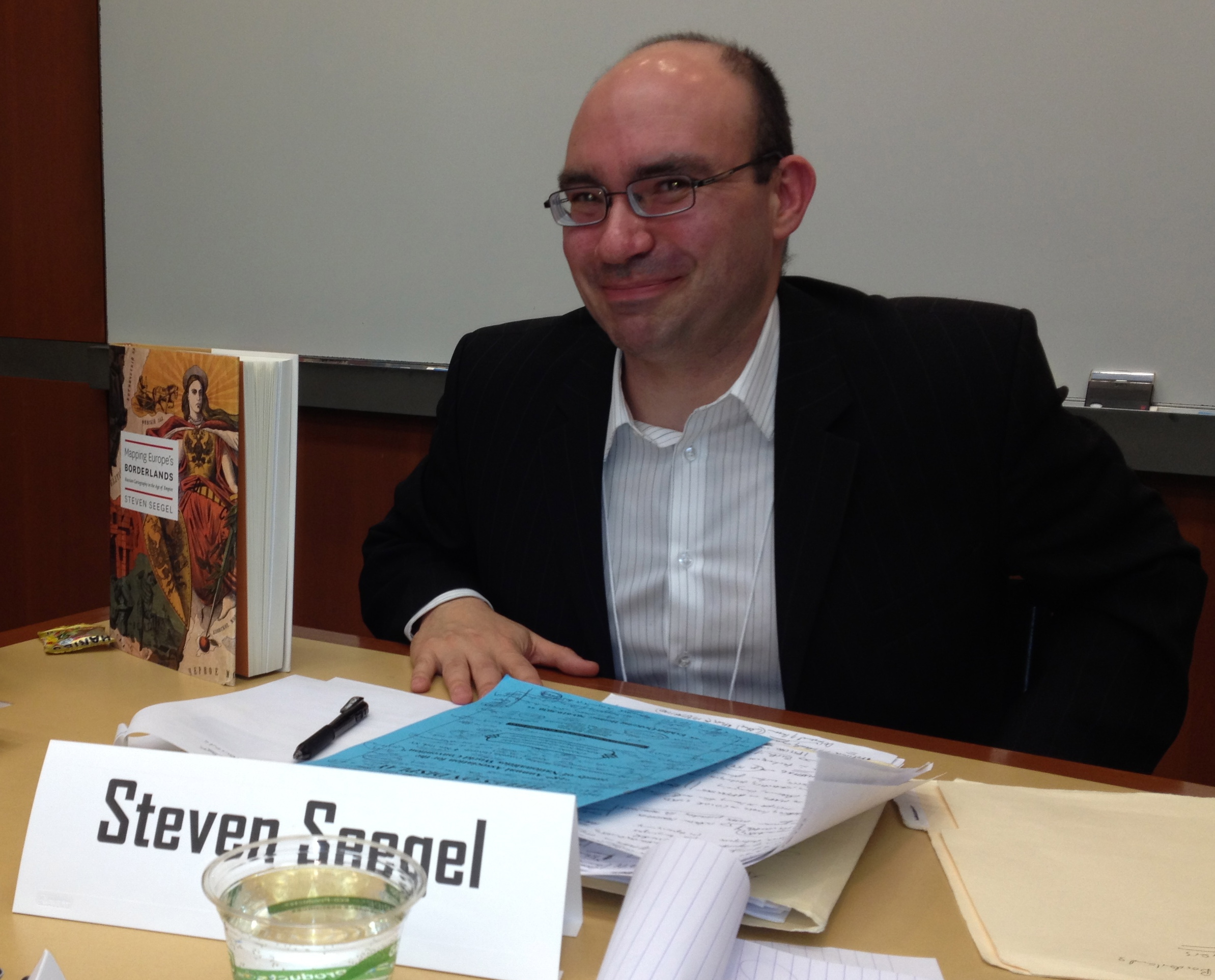
I was one of three discussants of Steven Seegel’s tremendously impressive book Mapping Europe’s Borderlands: Russian Cartography in the Age of Empire at the Association for the Study of Nationalities conference in New York on 18th April. Larry Wolfe in the Department of History at New York University and Monika Baar, in History at the University of Groningen, Netherlands and author of Historians and Nationalism: East-Central Europe in the Nineteenth Century were the other discussants. As Steven remarked, the panel had a scholar of the eighteenth century, one of the nineteenth century and myself as a representative of contemporary political geography. The discussion was lively and rightly acknowledged the tremendous academic work that went into creating this book. There was some commentary on the slightly misleading title and more obviously misleading subtitle of the book. But the University of Chicago did a beautiful job producing this volume, allowing abundant black and white map reproductions and eighteen pages of color plate maps at its center. Commentators will be gathering their thoughts for publication in a book forum in Nationalities Papers within the year.

Posted in Current affairs | Tagged , , , , | Leave a comment

The Improvised State

IMG_0770

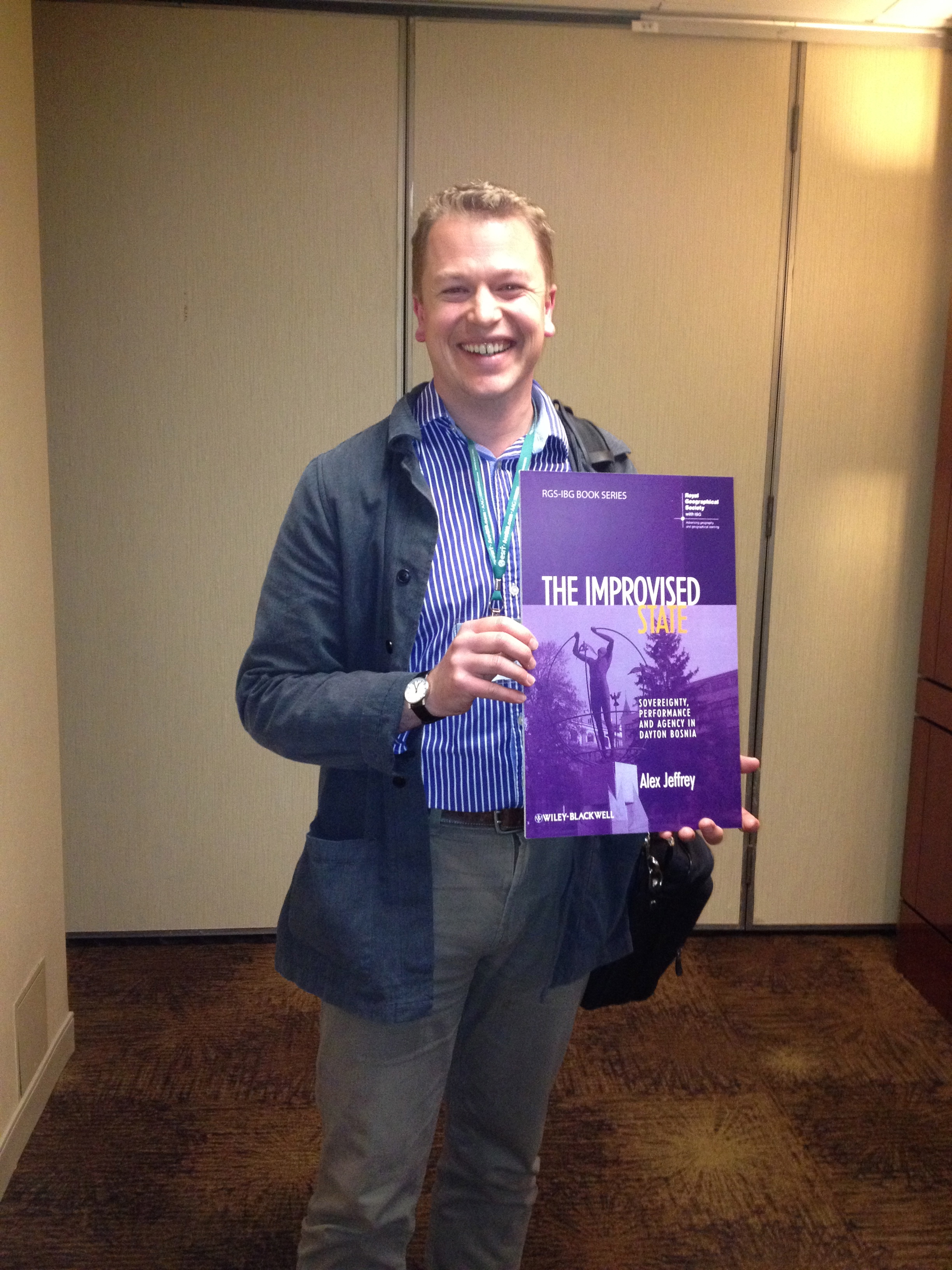
Alex Jeffrey is a lecturer in Geography at Cambridge University in the (maybe not so) United Kingdom (what say you Scotland?). He is the author of a theoretically innovative new book called The Improvised State: Sovereignty, Performance and Agency in Dayton Bosnia published by Wiley (pictured herein with the cover). He has also written a series of important articles on the ICTY and transitional justice mechanisms in Bosnia. I was among a panel of five discussants who engaged the book at the recent Association of American Geographers meeting in Los Angeles. The session was an interesting experience with one discussant remarking that it seemed we weren’t engaging the same book (which was really more a reflection of the different backgrounds of the commentators). My comments and those of the other discussants are likely to appear in a Political Geography book forum in the next year. Congratulations Alex on the book.

Posted in Bosnia, Bosnian war, Critical Geopolitics, Current affairs, Democracy, ethnic cleansing, ICTY, nationalism, Radovan Karadzic, state theory | Leave a comment

International Conference on the Future of Turkey and the Kurds

CALL FOR PAPERS:
International Conference:
The PKK, Kurdish Nationalism and the Future of Turkey
 Thursday, November 7, 2013
 Virginia Tech National Capital Region
1021 Prince Street , Alexandria, VA 22314

Organized and Sponsored by
School of Public & International Affairs, Virginia Tech, National Capital Region.
Ottoman and Modern Turkish Studies Chair (Indiana University)
 

We plan to organize an international conference on the PKK, Kurdish Nationalism and the Future of Turkey. This will be a one day conference with four specific panels. The conference will be held at the Virginia Tech Alexandria Campus, in the heart of Old Town, Alexandria, and the Washington DC metro region.
 
The objective of this conference is to understand the complex relationship between Kurds and Modern Turkey. The collapse of the Ottoman Empire left unprecedented political conditions in the region, with the formation of nation-states without any social and economic foundations. In this context, the new form of nationalism attempted to create a territory-based form of national identity; however, demographic challenges such as urban and rural demographic contradictions), a lack of higher education, lack of an established rule of law and of capital accumulation has led to instability and the formation of a non-organic type of modernization and national identity in the region and Turkey. In the meantime, transnational economic development has weakened the role of the nation-state over the last 30 years and ethnic nationalisms have emerged across the Middle East. This set the stage for the resurgence of Kurdish Nationalism in Turkey, Iraq, Syria and Iran. The Marxist-based Kurdistan Workers Party (PKK) first waged war against the Turkish Nation State in 1984. However, as a result of the social, political and economic transformations in the world and US involvement in the region, the PKK changed its ideological foundation from Marxism to nationalism in 1995, as part of the 5th PKK Congress. At this time, the Marxist star was removed from its flag and ethnic nationalist symbols and slogans were used to replace it. At the same time, more than sixty percent of the Kurdish population migrated to non-Kurdish industrialized cities in Turkey. Today, the Kurdish population in modern Turkey is more educated, urbanized, and they invest in the Western as much as the Eastern part of the country. Therefore, aspirations and objectives of Kurdish Nationalism is currently in a stage of transformation, and its objectives have begun to shift from that of obtaining an independent Kurdish State to seeking the status as equal citizens of modern Turkey. The latter objective – the integration of the Kurdish population into the larger population of Turkey – is likely to create numerous opportunities for the modernization of Turkey and the wider region. In this conference, we will explore this transformation, and possible future trajectories between Turkey and its relations with the Kurds.           
 
You will find detailed information about the conference below:
 
PANEL-1: Kurdish Nationalism in Iran, Iraq and Syria
We welcome submissions related to, but not limited to the following subjects:
•    Kurdish nationalism in Iran
•    Kurdish nationalism in Iraq
•    Kurdish nationalism in Syria
•    Kurdish nationalism in the Diaspora
 
PANEL-2: Kurdish Nationalism in Contemporary Turkey
We welcome submissions related to, but not limited to the following subjects:
•    Kurdish Nationalism in historical context
•    Kurdish and Turkish nationalisms
•    Imperialism and Kurdish nationalism
•    American foreign policy towards Turkey and the Kurds
 
PANEL-3: PKK and Kurdish Nationalism
We welcome submissions related to, but not limited to the following subjects:
•    Origin and development of the PKK
•    The PKK and the ‘war on terrorism.’
•    Relationship between the PKK, the US and Europe
 
PANEL-4: The Kurds and the Future of Turkey
We welcome submissions related to, but not limited to the following subjects:
•    The future relationship between Kurds and Turkey
•    JDP and Kurdish Nationalism
•    Kurdish regional government and Turkey
•    Future trajectories of American foreign policy towards Turkey and the Kurds
•    Future trajectories of Turkish and Kurdish politics  
 
Please submit your interest, with a short abstract (300-400 Words) and short bio (100-200 words). The deadline for abstract submissions is Monday, August 19th 2013. The authors of accepted papers will be notified by September 1st 2013.
 
Please submit your paper to the following address: tugrulk@vt.edu
 
If you have any questions, please do not hesitate contact us.
 
Dr. Kemal Silay, Professor of Turkish Language and Literature; Ottoman and Modern Turkish Studies Endowed Chair Professor; Director, Turkish Language Flagship Center; Director, Turkish Studies Program;

Indiana University

Dr. Tugrul Keskin, Assistant Professor of International and Middle East Studies; Affiliated Faculty of Black Studies Sociology, and Turkish Studies; Portland State University


Tugrul Keskin

Assistant Professor of International and Middle Eastern Studies
Affiliated Faculty of Black Studies
Sociology and Center for Turkish Studies
Middle East Studies Coordinator (INTL)
Portland State University

Editor of Sociology of Islam Journal (Brill)
http://www.brill.nl/sociology-islam
Book Review Editor for the Societies Without Borders
http://societieswithoutborders.com/  
International Studies and Global Sociology
http://internationalstudiesandsociology.blogspot.com/

Posted in Current affairs | Tagged , , , , , | Leave a comment

Geography’s Oscars: John O’Loughlin’s Distinguished Scholarship Award

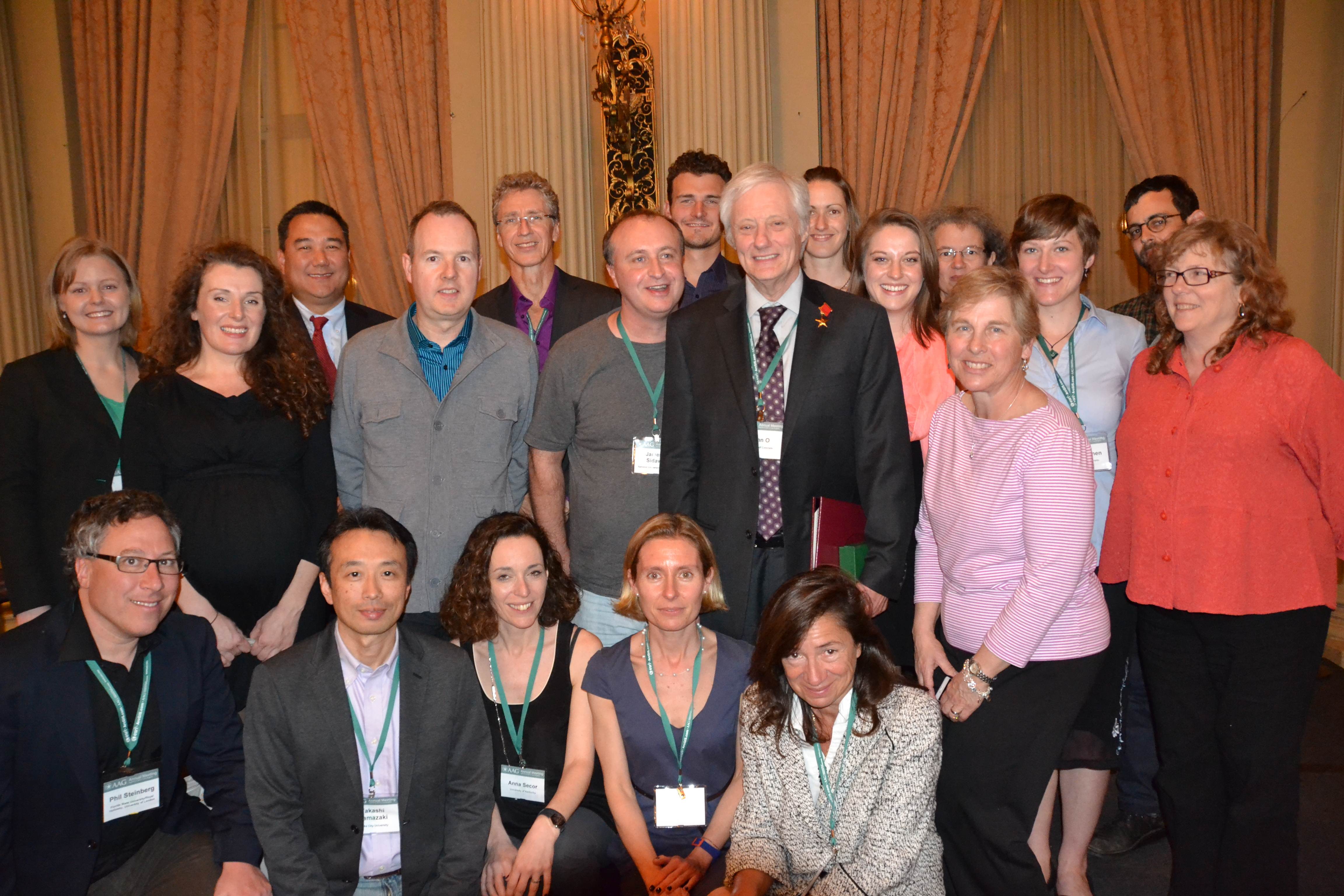
JohnoLunchGroup2The Association of American Geographers gathered in the Crystal Ballroom of the Biltmore Hotel on 13th of April 2013 for an awards luncheon. The location was an appropriate one to dispense awards as it was the site of a series of early American Academy of Motion Picture Arts and Sciences Awards. Among those honored was the great Edward Soja, fittingly feted in the city he has written about for decades, and Sally Marston. I was part of a two table group to honor my first graduate academic adviser, and ongoing research collaborator, Dr John O’Loughlin. JohnO as he is affectionately known by his now legions of graduate students and friends, was honored for Distinguished Scholarship, an award he richly deserves as he has produced a remarkable corpus of research articles and books from the nineteen seventies to today. He is also held in high esteem by his former and current graduate students, and others, for many many qualities beyond his research productivity and excellence. Exhortation to hard work through humor is an abiding quality, one suitably honored by his ‘clan’ with an extra award on the day, that of Soviet ‘Hero of Labor‘ (a category of praise he has used for decades for those slaving away on research projects). Unlike the Soviet original, this one was truly a ‘bottom up’ award for a genuinely inspiring figure in the discipline of Geography and beyond. Congratulations JohnO. ‘Tis a pleasure to be working with you.

POSTSCRIPT.

Sometimes you can’t make things up! Putin Brings Back ‘Hero of Labor’ Medal

Posted in Current affairs | Leave a comment

Conference Season

Each year different tribes of academic laborers have their trade shows. This laborer is attending two virtually back to back, the Association of American Geographers meeting in Los Angeles and then the Association for the Study of Nationalities conference in New York the following week. I’m involved in three events at each. At the AAG I am on two book panels. The first is on Alex Jeffrey’s The Improvised State: Sovereignty, Performance and Agency in Dayton Bosnia (Wiley Blackwell, 2012), the second Thomas Medvetz’s Think Tanks in America (University of Chicago Press, 2012). I am also presenting a paper, a gathering of thoughts on the August War of 2008, on the notion of ‘affective geopolitics’ in one session in a series on ‘Violence and Space’ organized by Simon Springer and Philip Le Billon at the Department of Geography at the University of British Columbia.

Like last year at the ASN, I am involved in the presentation of two papers. The first is “Land for Peace in Nagorny Karabakh? Political Geographies and Public Attitudes in a De Facto State” which is the latest in a series of papers from the De Facto State Research Project with Dr John O’Loughlin. The second is “Where is Serbia? Self-Positioning Traditions in Serbian Geopolitical Culture” which will be presented by and was mostly written by a visiting post-doc at Virginia Tech NCR, Dr Bojan Savic. Drafts of both papers are written and will be in the ASN conference CD. I am also a discussant at a book panel on Steven Seegel’s Mapping Europe’s Borderlands: Russian Cartography in the Age of Empire (University of Chicago Press, 2012). Lots of laboring ahead.

Posted in Caucasus conflict, Critical Geopolitics, Current affairs, De Facto States, ethnic cleansing, Five Day War, Nagorno-Karabakh, Nagorny Karabakh, nationalism, Political Geography, South Ossetia | Tagged | 2 Comments