Should the United States Save Syria?

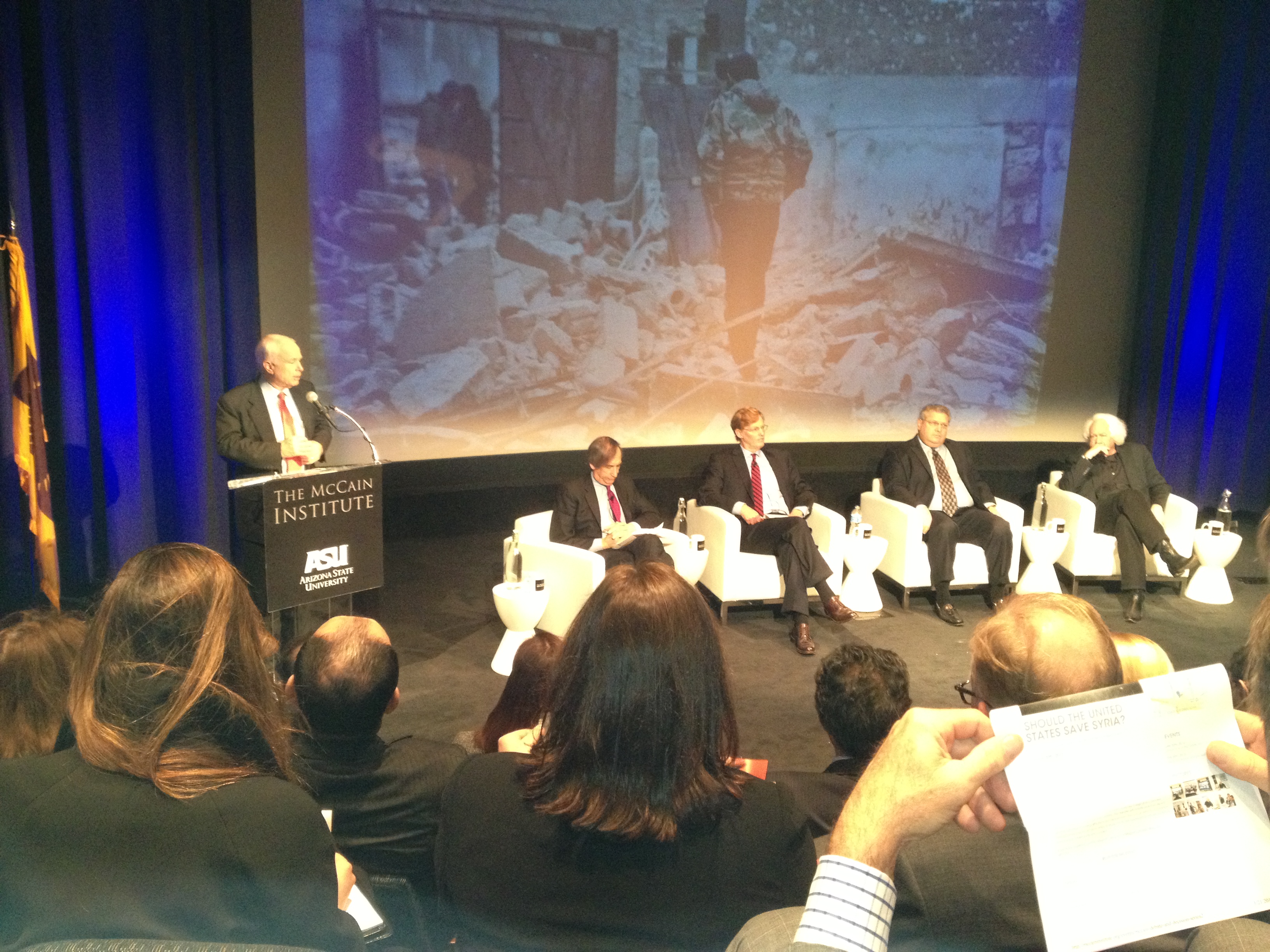
IMG_0623Yesterday afternoon I attended a debate organized around this question. The event was the first organized by a new ‘decision tank’ in Washington DC, the McCain Institute. Named after Senator John McCain, organized in collaboration with Arizona State University, and headed by former NATO ambassador Kurt Volker, the debate was the first in a series it is planning on key decisions facing US foreign policy. Teams of two, for and against the proposition, spoke. The ‘yes’ team featured Robert Kagan, Senior Fellow at the Brookings Institution, and Leon Wieseltier, Literary Editor of the New Republic. The ‘No’ team was Dr. Joshua Landis, Director of the Center for Middle East Studies at the University of Oklahoma, and Aaron David Miller, former US State Department official and now a Distinguished Scholar at the Wilson Center. Senator McCain introduced the proceedings and Brent Scowcroft was in the first row.
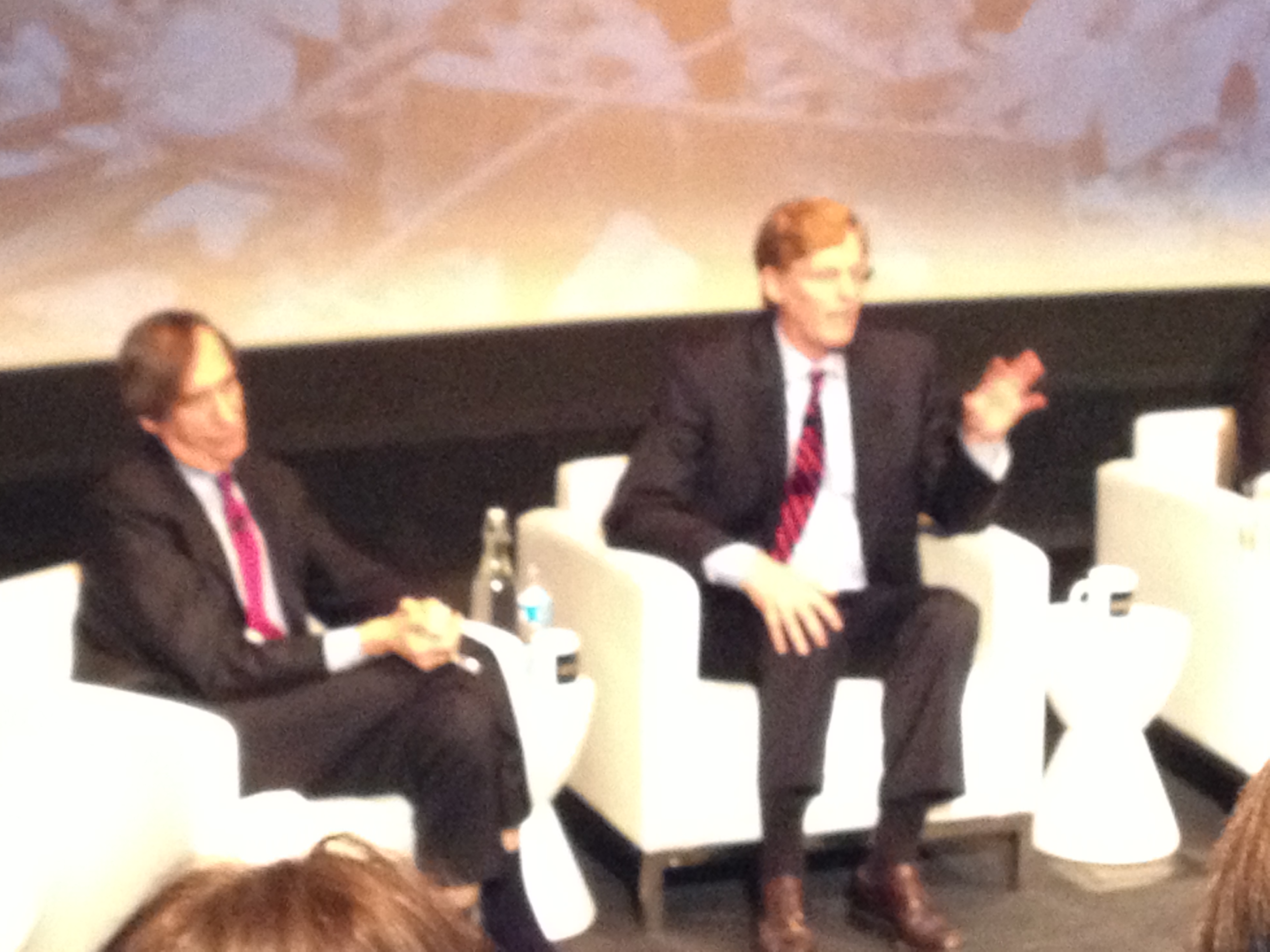
IMG_0626 The debate was fascinating. Ostensibly it could be described as a classic ‘idealist’ versus ‘realist’ debate. I think this characterization misses a lot. First, the debate featured generalists versus area experts, commentators with neoconservative principles versus, in Miller, a seasoned and, by his own admission, disillusioned practitioner and, in Landis, a grounded country academic specialist. Second,  this was a debate over the best US foreign policy and not the Syrian crisis. All participants held that the US had interests in the region, and in the conflict, but they differed in how important and vital they were. Wieseltier spoke of Syria representing a confluence of both interests and values. From a coldly realist perspective, he argued, it made sense that the US intervene to (i) prevent a failed state in a vital region (ii) be on the side of the opposition to a regime that is doomed (and thus have some credibility with the new regime and (ii) tilt the struggle towards secularist democratic forces and against Islamicist fighters. The longer the US delays in intervening, the more influence it looses. Third, there was little sustained discussion by all parties of the broader regional and international issues involved. Turkey was hardly mentioned, nor was NATO, the United Nations or even Israel. Wieseltier evoked Putin as a problematic player in the crisis and saw the Obama administration as hiding behind UN stalemate to justify a policy of dithering. There are larger geopolitical issues at stake, and Obama (to whom he contemptuously referred to as “the great extractor”) was withdrawing from these. Kagan shared this view and considered the crisis a test for US leadership and fidelity to its values as universal values. Fourth, the posed question revealed a meaningful divide. It was should (not can) and the United States (not the international community). The save construction has obvious problems in evoking missionary foreign policy. Landis underscored the consistent record of US interventionist failures in the region, in the Israeli/Palestinian conflict, in Iraq, and in Afghanistan. To the ‘no’ team, the empirical historical record revealed that the US can’t. This dictated a policy of pessimism: because the US can not control, the US should not intervene and, instead, let it ‘sort itself out.’ Only the Syrians can save Syria. This position has echoes of Edward Luttwak’s ‘give war a chance’ and the realist credo to ‘let civil wars burn.’ Kagan’s response was that the record of US foreign policy exceeds that of the last decade. He pointed to Bosnia as an example of a successful intervention. Unaddressed by this, and the larger debate, is the work required to put together a coalition involving the Russians (as Clinton did with IFOR/SFOR) to pursue a policy of coercive diplomacy eventually leading to a robust interventionist peace-making to peace-keeping force. This hard road was unaddressed by the ‘yes’ team, with Miller calling this failure out: “show me a strategy, something that could work.”
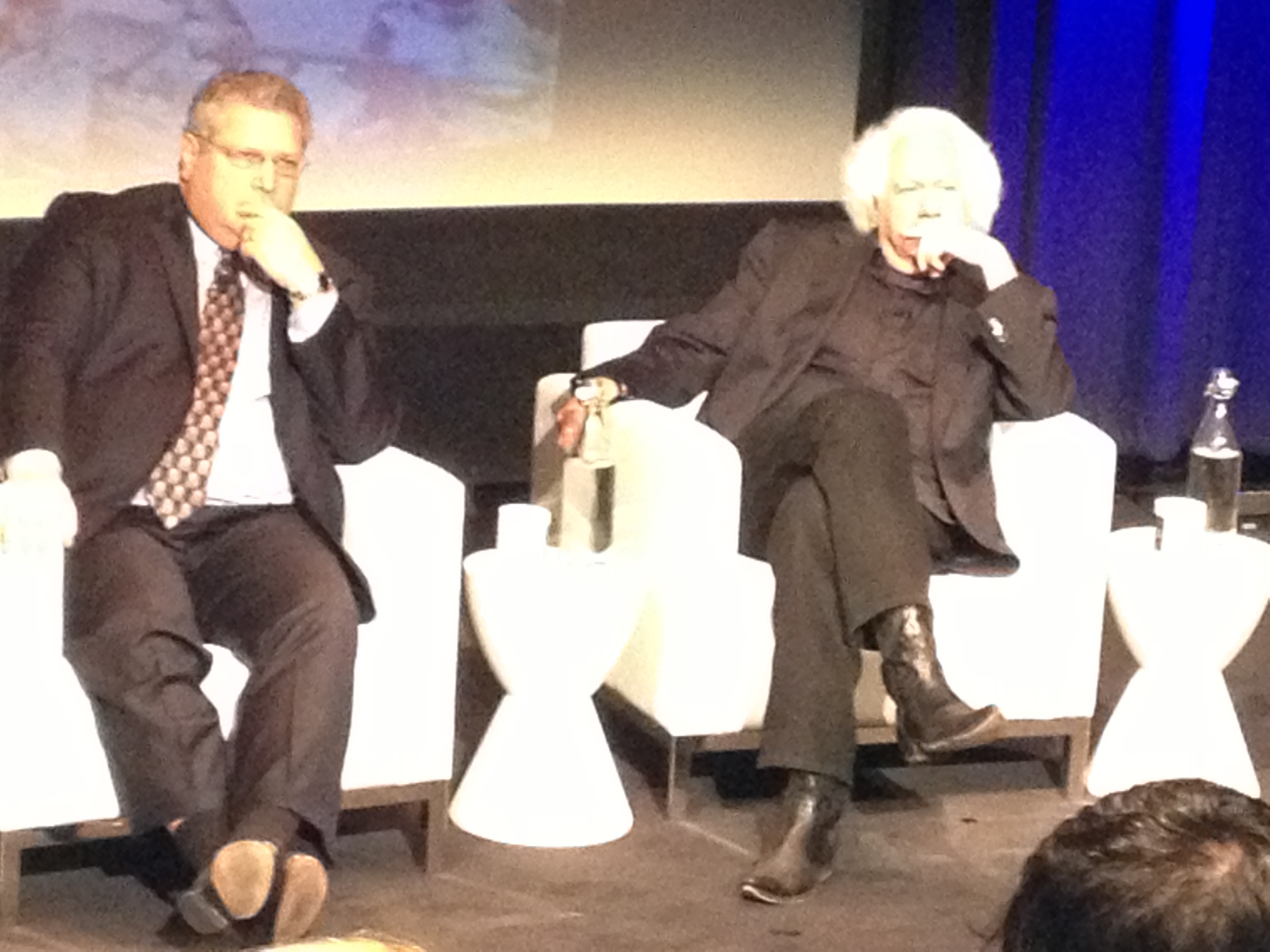
IMG_0625The crisis to Syria, to my mind, is a wicked problem. Kagan and Miller appeared to reach a degree of consensus that the US try a six-month policy of providing military aid to certain pro-western factions on the ground. Landis was skeptical. He pointed out that there are hundreds of different militias on the ground, that the strongest on the battlefield are Islamicist, and that the conflict is now deeply sectarian and ‘ethnic.’ Minorities are clinging to the regime, and if its falls then there will be large scale ethnic cleansing as the Alawites flee. A related alternative scenario is that the country break up into different ethnic homelands: Kurds in the north, Alawites on the coast and Sunnis elsewhere in the country. I found Landis’s easy recourse to ‘ethnic conflict’ language and terms intellectually unsatisfying in that a particular conjunctural national revolution against an oppressive regime is now read in primordial sectarian terms. But perhaps his argument is that it has become that, that the regime has successfully ethnicized the field. Remember that language was also used in Bosnia and it missed many important aspects of that conflict.

My position on the conflict has long been that Turkey holds to key to more robust intervention. To make this happen, however, the Turkish state must have a reconciliation with the Kurdist groups in the north (here its excellent relations with the Kurds in Iraq could help). They should not be threatened by Turkish intervention to establish a humanitarian ‘no fly’ zone in the north. The US should work hard to forge a joint policy with the Russians, and that should involve some level of agreement that Assad should go, but that the new government be one that gives all groups a stake in the country. This will be hard and may not be impossible but an environment that incentives this is preferable. Syria is not a US problem or responsibility. Its a regional one, and an international one. The current levels of brutality and killing should be unacceptable to the international community. Preventing Syria becoming a failed state is a regional and international strategic interest.

Critical geopolitics, I would argue, leads one to reject the prevailing dichotomies of foreign policy debate. I’m neither an idealist nor a realist. I’m for worldliness in foreign policy practice, one that is grounded in the particularities of places/regions and independent of the easily deployed formulaic categories that attend both primordialism and national exceptionalism.
Posted in Current affairs, John McCain, Syria, US Senate, Washington D.C. | Tagged | 1 Comment

Bend it like ‘Bama

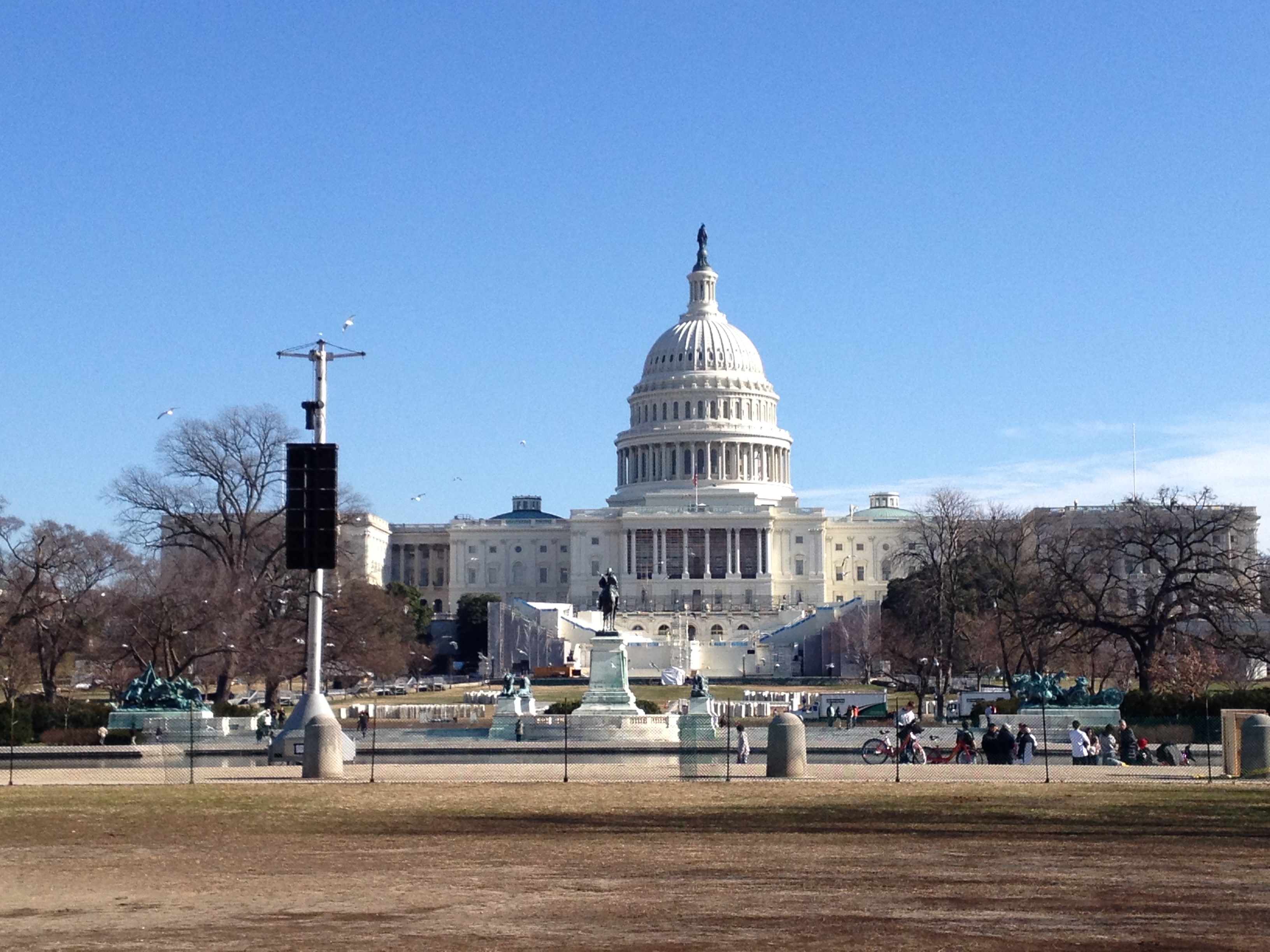
So what have one million people done to my football pitch? Has majestic battle hymn IMG_0524democracy destroyed the ground friends and I play soccer upon every Sunday? Well I suppose an alliterative public extension of the bonds of inclusion in front of millions (especially John Roberts) is worth a little turf destruction. And a public articulation of the communal bonds that make individuality, enterprise and other commonplaces of liberal mythology possible a worthwhile learning moment for the student citizens on the Mall. And a call out about the storms coming another useful moment of sense making against the Age of Stupid (and the hydrocarbon lobby’s lock on the dome). All together it was  a welcome further bending of that arc of the moral universe….

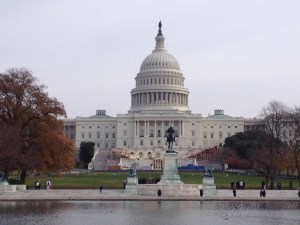
Here’s my pre-inauguration photo of the pitch. What will it look like this Sunday?

Posted in Current affairs, Democracy, Obama, Washington D.C. | Leave a comment

Power and Political Geography

Very useful 11 minute segment last night on the Rachel Maddow Show on the question of the alleged gerrymandering of Congressional Districts in Michigan, Wisconsin, Ohio and Virginia. Useful teaching resource and illustration of the power of political geography. It helps explain why the US had an election but political geography kept things the same. Interestingly if the US was to move away from a state-based awarding of electoral college votes for President to a Congressional District one (currently only used in Maine and Nebraska), then Romney would have won the presidency. These are yet more arguments for abolishing the electoral college, allowing a popular vote for president, and reforming election law in the United States. But its not a matter of arguments….


Posted in Current affairs, Political Borders | Tagged , , , | Leave a comment

“We have to fix that”

IMG_0167Among the many pleasures on election night last month was seeing the fire in Obama’s eye as he went off script — “by the way, we have to fix that” — during a wonderful election night speech. He was referring to the exceedingly long voter lines and shambolic voter administration in many parts of the country, particularly Florida, Arizona and Ohio. These were symptomatic of deeper structural problems, some of which are the product of political design (GOP voter suppression efforts) and some of plain dysfunctionality in election administration. Apparent on election night, and in the election campaign, is a major reform agenda, one that should be focused around the achievement of deeper democracy in the United States in the twenty first century. The problems are clear, and the solutions ones that will have to fought for against forces of reaction, cynicism and indifference. The first roadblock these forces will toss out is myopic national exceptionalism: “we have the best election system in the world.”

The Guardian journalist and historian Geoffrey Wheatcroft provides an interesting contrast between the US and the UK in an argument to the contrary. Whereas the US political system was once at the vanguard of modernity, now it is an antiquated relic, its structural features sharing more with the eighteenth century world than that of the twenty first century. His conclusion:

If the American system is antiquated and dysfunctional, that dysfunction is preordained. Institutions designed 230 years ago for a handful of almost entirely agrarian colonies on the Atlantic coast with a population of fewer than four million (including slaves) are supposed to operate in a vast, advanced industrial nation of 314 million. Is it any wonder they don’t work? And mightn’t the Americans have something to learn from us, rather than we from them?

The tip of the spear of reform will be upon us soon in 2013 when the new Senate, on its first day, takes up the issue of filibuster reform. Harry Reid needs to get this done, and do so boldly. Here are a few other reform measures needed.

  1. A National Voter Administration agency. Congress can legislate the creation of a non-partisan technocratic agency  whose job it is to register voters (this should be done by default, and those who don’t vote forced to pay a penalty like in Australia, though that system isn’t a perfect model). Rick Hasen has proposed a federal agency and his blog is a great resource for election law issues. This agency should also be charged with drawing Congressional districts on non-partisan criteria. It can be paid for by taxing corporate campaign donations if there are to be retained as the nostrums of a reactionary Supreme Court (SCOTUS) — ‘corporations are people’ & ‘money is speech’ — are likely to be with us for a while.
  2. Campaign finance reform which ushers in public financing of election campaigns. Media communication outlets should be mandated, as part of their licenses, to provide free airtime to qualifying candidates. There are lots of great public interest ideas out there.
  3. A Constitutional Convention to reform Congress (how about a push for one in 2020? My guess is that the need for this will be discussed much more by that date than it is today but it is unlikely for quite a while). Sample reforms could include extending the Presidential term to 6 years; abolition of the unrepresentative US Senate (or its reform so each Senator represents at least 3 million people, or taking a Senate seat from Wyoming and giving it to Washington DC), and the creation of a 4 year House of Representatives. The Electoral College, a legacy of slavery, could be abolished without this, of course.

It can be argued that the GOP majority in the 2010-2012 House was largely a product of gerrymandered districts and relatively low voter turnout. It was more than this: the new post-Citizens United world also helped the GOP, and its message still resonates with a good portion of the country. Now, despite the fact that a million more people voted for Democrats than Republicans last month, the GOP has retained its majority in the House, and we’re faced with more dysfunctionality and gridlock.

The “great experiment in democracy” is coming to terms with America’s changing demographics. The hegemony of “traditional America” is fading. In the twenty first century it needs a democratic system that empowers all its citizens, not one originally designed to protect aristocratic power, racial hegemony and established interests from popular sovereignty.

Time for some ‘democracy promotion’ at home.

Posted in Congress, Constitution, Current affairs, Democracy, Obama, US Senate, Washington D.C. | Leave a comment

Slow Knowledge

It is good to know that, in this globally connected world of ever increasing turnover speeds and response times that there is something still stuck in the groove of the nineteenth century: academic publishing timelines! The following are some articles scheduled to appear in early 2013 and when the research on them began:

  • “Republika Srpska will have a referendum”: the rhetorical politics of Milorad Dodik. This piece has turned out to be the longest journal article I have ever written. I just completed reviewing 40 pages of proofs. I am very grateful to Florian Bieber for being open to publishing such a piece in Nationalities Papers. After supervising a Masters thesis on the topic by Adis Maksic in 2009 (who became ABD at Virginia Tech in November and is currently in Sarajevo researching his dissertation), we decided to write a joint article on the topic together (which appeared in 2001 in Eurasian Geography and Economics 52, 2, 279-293). The launch of Bosnia Remade stimulated me to continue reading and writing about Bosnian politics, particularly about Dodik’s rhetorical gambits (Carl Dahlman and I met Dodik in Bosnia in 2004, and I met him again in Washington DC). I ended up writing an in-depth history of RS politics since 2005. An initial version was submitted in March 2011, and a revised version submitted in January 2012. Thankfully the RS hasn’t held a referendum in between the paper being accepted and published. But I guess there’s still time!
  • Inside South Ossetia: A Survey of Attitudes in a De Facto State. This is a joint piece with Dr John O’Loughlin that is based on our March 2010 research fieldtrip there and subsequent commissioned survey research. I began writing this in the summer of 2011 but it took us over a year to clear time and co-ordinate our schedules sufficiently to finish it. It will appear in Post-Soviet Affairs like the previous piece on Abkhazia, hopefully the first issue of 2013.
  • “Cartographic Exhibitionism? Visualizing the Territory of Armenia and Nagorny Karabakh.” I enjoyed writing this piece with Laurence Broers in February-March of this year. We presented it at the ASN 2012, and immediately sent it off for review. It was quickly accepted by Problems of Post-Communism but it is not scheduled to appear in print until May 2013 from what I understand.

The paper Adis Maksic and I also presented at the ASN 2012 was also immediately sent off for review, but I still have not heard back from the journal — now the 8th month of waiting — despite the fact that an editorial assistant at the journal indicated that reviewer comments are in. That was over a month ago! Fortunately the paper is on a historic not current affairs topic.

A paper on Abkhazia, on which I was one of four authors, should appear in International Studies Quarterly if our revisions are accepted.

I’m currently working on a paper on political geographies of Nagorny Karabakh with JohnO, and one on Serbian geopolitical orientations with Bojan Savic, a post-doc from the University of Kent currently at Virginia Tech National Capital Region for the year. JohnO and I are also looking to gather together some of our survey findings from all four of the de facto states we have studied. I expect we’ll be working on that early in the New Year. We present on the topic at INR in the US State Department in mid-January.

And then there’s the small matter of my book project on the US and the August 2008 War. At this rate it will be done by the 10th anniversary of the war….


Posted in Current affairs | Leave a comment

Does global warming auger increased levels of violent conflict?

There has been a lot of speculation on the likely impacts of global warming on violent conflict across the globe. In a new study published in the Proceedings of the National Academy of Sciences (PNAS), my former adviser and research collaborator Dr John O’Loughlin and a team of his graduate students at the University of Colorado, Boulder, present research results on this question examining violent events in East Africa. Their conclusion? Much warmer temperatures raise the risk of violence….

But there’s a lot more to it than that. The short article (warning: its highly technical) is available on open access:

http://www.pnas.org/cgi/doi/10.1073/pnas.1205130109

Congratulations to them on publishing in such a prestigious journal, a first ever for political geographers.

Posted in Africa, Climate Change, Current affairs, Geography, Global Warming, World political map | Tagged , , | Leave a comment

The Third Debate: Politics is the Enemy of Strategy

The third debate introduced US citizens, and an international audience to a geographic variant of a staple political attack.

And, you know, Governor Romney, I’m glad that you agree that we have been successful in going after Al Qaida, but I have to tell you that, you know, your strategy previously has been one that has been all over the map and is not designed to keep Americans safe or to build on the opportunities that exist in the Middle East.

“All over the map” is flip-flopping in geopolitical argot. Yet discussion here was firmly anchored in the Middle East, and characterized by an unusual level of agreement. If there was one striking feature of the third debate, it was how little genuinely strategic places, and collective security interests, were even mentioned. No discussion of the European Union and the Euro currency crisis. No mention of India or Brazil, the other two BRICs getting cited only within the context of threat and trade discourse. No mention of climate change, nuclear weapon proliferation (beyond a passing comment on Nunn-Lugar), Indonesia and global health issues.Instead the debate remained largely mired in the Middle East – though Obama, to his credit, made mention of his ‘pivot to the Pacific’ towards the conclusion -, with some time later on China and trade, and, in the silliest expression of the night, a possibly US ‘divorce’ from Pakistan. (In keeping with past practice, the campaigns choose a weak US journalists to moderate, and the resultant level of questioning was an embarrassment to the profession).

The level of agreement between Obama and Romney on Israel, Iran and Syria does not serve the US public well. Students of US foreign policy will recall chapter (lesson) 3 in Gordon M. Goldstein’s Lessons in Disaster: Politics is the Enemy of Strategy. The chapter concerns how US decision-making on Vietnam in 1964 was shaped by the interests of the Johnson presidential campaign of that year. Marketing a politically palatable position, Goldstein’s argues, was more important than developing a strategically sound one. Hard policy decision-making was postponed, deferred and delayed. The same can be said of current US policy on Israel and Iran (and possibly Syria). The US government has so intertwined itself with the current government of Israel that it has created the remarkable dangerous situation of letting Benjamin Netanyahu’s domestic political calculations inordinately determine US foreign policy in this region. Bipartisan consensus on Israel has created a dangerous myopia on how US national security interests are understood in the region, and beyond. So also on Iran. The current US policy position, a blanket refusal to accept Iran with a nuclear weapon, has important shades of grey (is this ‘nuclear capable’ or ‘nuclear armed,’ and what leader gets to define how the former in particular is determined). But, lets be clear, it commits the US to go to war against Iran should it decide to do what the United States, Israel and many other nuclear capable states have done before, namely develop nuclear weapons as a national security strategy. There is no Plan B here, no questioning of the premises of this incredibly dangerous policy. It needs to be stated clearly: preventing an Iranian nuclear bomb is not a vital national security interest of the United States (just as preventing a Russian, Chinese, Israeli, Pakastani, and North Korean bomb turned out to be something the US and others could live with because deterrence is a compelling factor in international affairs). But again there is group think on this question across the political spectrum, with some of Romney’s loose talk on this issue echoing Barry Goldwater’s position on Vietnam in 1964. In that election, the triumph of politics over strategic debate, and clear thinking, had tragic consequences. One cannot be confident that history won’t repeat itself after this election.

Posted in Current affairs, Geography, Iran, Israel, Obama, Rhetoric, Romney, the bomb, World political map | Tagged , , | Leave a comment

“Just give me the ball”

In his article entitled “Battle Plans: How Obama Won,” the New Yorker writer Ryan Lizza records the following exchange between Obama and a staffer over Obama’s strong performance in his first debate with John McCain:

After Obama’s first debate with McCain, on September 26th, Gaspard sent him an e-mail. “You are more clutch than Michael Jordan,” he wrote. Obama replied, “Just give me the ball.”

Obama showed up for the Hofstra University debate and played an outstanding game, strongly aggressive from the outset, coolly scoring points when it was his turn, and unruffled by barging ‘in-your-face’ tactics by his opponent. The debate was the most intense debate I’ve ever seen in a US Presidential election, and as a political junkie I’ve been watching them since I first landed on these shores in the time of Reagan. I’ve learnt over the years that who I’ve held as the winner is not whom the press and conventional wisdom deems the winner. Mondale was more coherent than Reagan, Dukakis more persuasive than Bush senior, Clinton better than Bush senior, Gore stronger than Bush junior and Kerry clearly superior to Bush’s performances in 2004. But the GOP politico professionals were very skilled at leveraging emotional impressions, unconscious observations, and extra-discursive mannerisms, to turn substantive defeat into affective victory. In the downscaled world where they wanted to play the “guy you’d like to have a beer with” should be president (in Bush junior’s case, hopefully drinking non-alcoholic beer).

So, after a candidate that was a recovering alcoholic, the GOP now has one that doesn’t drink! In affect world, this creates ‘likeability’ problems. So an alternative strategy is to sell the candidate as a take charge ‘job creator’ who understands your problems and will aggressively move to fix them (on ‘day one’). Instead of an equal to watch football with, you get a superior, a patriarchal leader, a tad pushy and aggressive.

The GOP’s skill at affective spin was evident after the first debate, which provided lots of rich material. Obama was strong on substance and policy but lost on all affective criteria. So he needed to come back strong. And, since sports is more than a framing metaphor here but the experiential field for Obama (famously still playing competitive basketball at 51) and template for understanding for many of the viewing audience, it was ‘game on’ in Hofstra, and game metaphors de rigueur thereafter in the commentary.

Romney did well but Obama was better than him, the issue of Benghazi being a particularly powerful response.

For all its fascinating dimensions, this debate did have a gendered dimension that I think might grow in time. It was alpha male combat, an aggressive game played by both at a high intensity. While many may have found it compelling I expect some found the spectacle a bit ugly and repulsive. Not everyone likes competitive sports, and not everyone finds it enlightening to have two presidential figures debate like they did in New York. The degree to which that alternative affective reaction exists, a dis-identification that imagines alternative form of political debate, could condition whether we will see a woman president in the future. I hope it does.

Posted in Gender, Masculinity, Obama, Romney, Washington D.C. | Tagged , , , | Leave a comment

Diary: Lectures in Ireland and Istanbul

John O’Loughlin and I gave a lecture “Inside Eurasia’s De Facto States” at Dublin City University to students and faculty on the 28th of September 2012. Many thanks to Donnacha O’Beachain for organizing this well attended event. It was the first time I had ever visited this campus. Twas great to see so many Irish students interested in politics in the Caucasus and Moldova/PMR, and that such an interest can be pursued within Irish universities. It is quite a change from my time (not to mention that of JohnO who was introduced with amazement that he was part of the ‘class of 1969’ at UCD).

While in Ireland, I learned the terrible news that Neil Smith had died. His passing at a relatively young age is a major loss to the discipline of Geography. His biography of Isaiah Bowman is an outstanding piece of scholarship, one that justly deserved the awards it garnered. Like many geographers I have happy memories of Neil in social settings but also as an academic in intellectual exchange, beginning when he was at Columbia and then at Rutgers University. I was close with some graduate students of his while at Syracuse University in the eighties. He was a warm hearted man who gave generously of his time to younger scholars and inspired us all to critical thinking. I grieve for him, and I know many others, closer to him than I in recent years, are in pain too over his passing.

Thereafter I flew to Istanbul to participate in an International Congress to mark the 100th anniversary of the Balkan Wars: “Good Neighbourhood Relations in the Balkans.” Organized by the International Relations department at Hacettepe University in Ankara, this conference brought together 130 participants from 22 countries, most from the Balkans, to discuss the legacies of these wars. Valery Perry and I presented papers on Bosnia, mine on the 1990 elections and Valery’s on the dilemmas of constitutional change there. A big thanks to Muge Kinacioglu, her department and students for organizing such an ambitious conference, appropriately in YeniBosna in Istanbul.

On 6 October I also spoke on Critical Geopolitics and IR at the invitation of the Center for Global Studies of the Foundation for Sciences and Arts (Bilim ve Sanat Vakfi Kuresel Arstirmalar Merkezi). Many thanks Dr Mustafa Ozel for making this happen, and especially to Ozcan Sahin and Dr Murat Yesiltas for great hospitality during my visit (pictured). I was humbled by the generosity of my hosts in both instances, inspired by the intellectual vitality of Turkey’s young academics (Behlul Ozkan generously gave me a copy of his new Yale University Press book), and awed by the relentless expansion of Istanbul itself.

Posted in Current affairs | Tagged , , , , , , | Leave a comment

One of Our Own

Last week our School, the School of Public and International Affairs at Virginia Tech, lost one of our Ph D students in Afghanistan. Born in Egypt, Ragaei Abdelfattah was a naturalized American, devout Muslim and former master planner for Prince George’s County. Ragaei Abdelfattah was killed by a suicide bomber in eastern Konar province of Afghanistan, where he worked on building schools and hospitals as well as providing electricity as a USAID Foreign Service Officer. The attack also took the lives of three ISAF soldiers.
Ragaei entered the doctoral program (as a full-time student in Blacksburg) in the College of Architecture and Urban Studies in Fall 2003  to study planning and affordable housing. Earlier in his career he worked on international resort and eco-tourism development and on school development in Minneapolis.  As a doctoral student in SPIA and research assistant at the Center for Housing Research, directed by Dr Ted Kobel, he contributed to improving services to the chronically homeless, redevelopment planning, and affordable housing. I did not know Ragaei personally but he sounds the very antithesis of another urban planner from Egypt, Mohammad Atta.

A brief note about him in the Washington Post is here; on the Facebook page there is a SPIA obituary. See also the article by Josh Rogin in Foreign Policy.

Ragaei’s heartbreaking death underscores the tragic condition of US foreign policy in Afghanistan at this moment. He was part of the ‘civilian surge’ and the ‘development’ leg of the ‘defense and diplomacy’ triad that Hillary Clinton spoke of when she became Secretary of State. It is an admirable effort yet it is caught in the contradictions of counter-insurgency which requires (i) trusted and credible local government partners on the ground, and in the presidential palace in Kabul, and (ii) the sustained commitment of financial and military resources to ‘stabilize, hold, and transfer.’ The first condition is variable at best while the second condition is disappearing. What will be left, what will endure is uncertain.

From the various books that have appeared on foreign policy debates inside the Obama White House, it is clear that Obama took the time to carefully delimit his Afghanistan policy, initially rejecting the narrow counter-terrorism mission vision of Biden and others in favor of a more expansive COIN related ‘surge’ on both the military and civilian side. But he moved up the timescale for this to wind down, and that is now upon us. The US is leaving Afghanistan (or, more precisely, dramatically reducing its military footprint), and from a grand strategy perspective, that is a positive thing as no state should be committed to expending precious resources in strategically marginal places. Getting to the point where the US could re-define Afghanistan in these terms has taken time, and the fading of the trauma of 9-11.

Biden spoke in Blacksburg yesterday in a moving way about our own 17 April 2007 tragedy. He’s been through this himself and brings an authenticity that no one can match in situations like this (Jules Witcover’s biography on him is an enjoyable read). Long may he remain ‘unchained’ to speak his mind.

Posted in Current affairs, Obama, Washington D.C. | Tagged , , | Leave a comment